
Accidental Death Benefit Insurance (ADB): What It Covers, Cost & Exclusions
Accidental death benefit insurance is usually an added rider on a life insurance policy that can pay an extra benefit if death happens because of a covered accident.
That is why this page matters. Most people are not just asking what accidental death benefit insurance is. They are asking whether it is the same thing as AD&D, whether it replaces real life insurance, what exclusions matter, and whether paying extra for it actually makes sense.
The real question is not just what an accidental death benefit rider does. The real question is whether this rider adds useful supplemental protection or whether you would be better off simply increasing your base life insurance coverage.
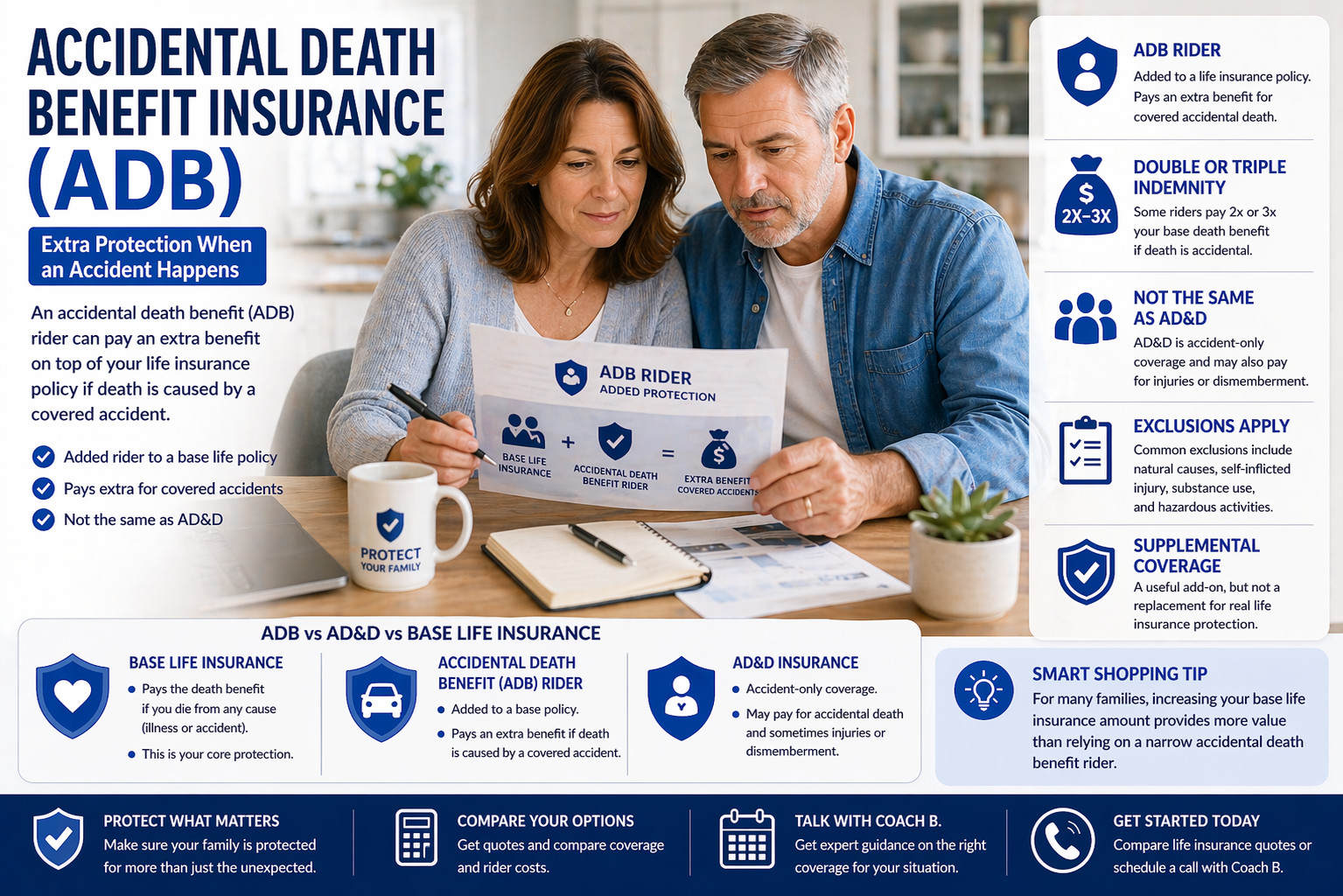
- Accidental death benefit insurance is usually a rider added to a base life insurance policy.
- It can pay an extra benefit if death happens because of a covered accident.
- It is not the same thing as AD&D, and it definitely is not the same thing as base life insurance.
- Common exclusions and the policy’s definition of “accident” matter a lot.
- For many families, increasing the main life insurance amount is often more valuable than relying heavily on accidental-death-only coverage.

Scott Benton (a.k.a. Coach B.)
Author: Scott Benton, Licensed Life Insurance Agent
Experience: Serving families since 1992
Disclosure: Coach B. Insurance may be compensated if you purchase through our agency. Recommendations are based on product fit, underwriting, clarity, and usefulness — not pressure.
Editorial note: This page is not about whether accidental death is covered by normal life insurance. It usually is. This page is about the extra accidental death rider that can sit on top of a base life policy and whether that extra premium is really worth it.
What Accidental Death Benefit Insurance Usually Means
Accidental death benefit insurance usually means an added rider attached to a life insurance policy that increases the payout if the insured dies because of a covered accident. In plain English, the main policy pays its regular death benefit, and the rider can add extra money if the death meets the rider’s accident definition.
Usually a rider
It is commonly an add-on to a base policy rather than the base policy itself.
Pays extra, not instead
The accidental death rider is usually designed to add to the payout, not replace the main death benefit.
Accident definition matters
How the rider defines a covered accident can determine whether the extra benefit is actually paid.
Supplemental coverage
This is usually a supplement, not a complete family-protection solution by itself.
Accidental Death Benefit vs AD&D vs Base Life Insurance
| Coverage Type | What It Usually Does | Main Limitation |
|---|---|---|
| Base life insurance | Pays the death benefit if the insured dies while the policy is in force, typically whether death is from illness or accident | Does not usually pay an extra accidental-only bonus |
| Accidental death benefit rider | Adds extra benefit on top of the base policy if death is caused by a covered accident | Only works for covered accidental death situations |
| AD&D insurance | Accident-only coverage that may pay for accidental death and sometimes covered dismemberment or injury losses | Does not replace broad life insurance because illness-related death is not the main point of coverage |
This is where most confusion happens. The rider, the accident-only policy, and the main life insurance policy are related ideas, but they are not the same thing.
What the Rider May Cover
Covered accidental death
The core purpose is usually an added payout if death happens because of a qualifying accident.
Double indemnity style benefit
Some riders are designed to pay an additional amount that effectively doubles the payout.
Sometimes higher multiples
Some policies describe certain accidental-death riders as double or triple indemnity, depending on the contract.
Policy-specific rules
The exact payout structure depends on the rider form, the company, and the contract language.
Common Exclusions People Miss
Natural-cause death
A normal illness-related death usually does not trigger the accidental death rider’s extra payout.
Self-inflicted injury
Self-inflicted injuries are a common exclusion area in accident-focused coverage.
Substance-related events
Accidents occurring under the influence may be excluded or contested depending on the policy terms.
Hazardous activity carve-outs
Certain high-risk activities or occupations may also be limited or excluded by some contracts.
Why Many Families Should Compare This Against More Base Coverage
Why people like the rider
- it can look inexpensive compared with adding a lot more main coverage
- it adds extra accidental-only protection
- it may feel like a low-cost supplement for people with higher accident concern
Why base life insurance often wins
- base life insurance usually pays for both illness-related and accidental death
- the family is protected across more real-world scenarios
- you are not relying on a narrower accident definition to create the extra value
For many households, the best question is not “Should I buy accidental death benefit insurance?” The better question is “Am I already underinsured on my main life insurance amount?”
Who the Rider Usually Fits Best
People with a solid base policy already
The rider makes more sense when the main policy is already doing the core protection work.
Shoppers wanting supplemental protection
This is usually a supplement for a narrow concern, not the foundation of the plan.
People who read exclusions carefully
The more you understand the contract language, the more intelligently you can judge whether it is worth the cost.
Not ideal as a replacement
If this rider is being used instead of real life insurance, that is usually the wrong setup.
How Coach B Would Shop This
Step 1: fix the base coverage first
I would first make sure the main life insurance amount is strong enough before spending too much time on accident-only extras.
Step 2: compare the rider against plain extra coverage
Then I would compare the rider cost against what it would cost to simply buy more real life insurance.
Step 3: read exclusions before deciding
If the exclusions or accident definitions are too narrow, the rider may sound better on paper than it is in practice.
The Bottom Line
Accidental death benefit insurance can add meaningful extra protection in a narrow lane: covered accidental death.
But it is still a narrow lane. For many families, stronger base life insurance coverage is usually the more important move. The rider can make sense as a supplement, but it should not distract you from the bigger question of whether your main policy is already doing enough.
Helpful Related Pages
Accidental Death Insurance
Best next page if you want the broader accidental-death and AD&D overview before comparing this rider.
Explore Accidental Death Coverage →Accelerated Death Benefit Rider
Best next page if you are trying to separate accidental death benefit from accelerated death benefit.
See Accelerated Death Benefit →Term Life Insurance Hub
Best next page if your bigger question is whether your core life insurance amount is large enough in the first place.
Explore Term Life →Life Insurance Calculator
Best next page if you need to estimate the right base coverage amount before worrying about riders.
Use the Calculator →Frequently Asked Questions
What is accidental death benefit insurance?
It is usually an added rider on a life insurance policy that can pay an extra benefit if death happens because of a covered accident.
Is accidental death benefit the same as AD&D?
Not exactly. An accidental death benefit rider is usually attached to a base life policy, while AD&D is usually accident-only coverage that may also include dismemberment benefits.
Does normal life insurance already cover accidental death?
Usually yes. Base life insurance generally pays the death benefit whether death is from illness or accident, as long as the policy is active and no relevant exclusion applies.
What are common accidental death rider exclusions?
Common exclusion areas can include natural-cause death, self-inflicted injury, substance-related events, and some hazardous activities or occupations depending on the contract.
Is an accidental death rider worth it?
It can be worth it as supplemental protection, but many families should compare it against simply buying more base life insurance first.


