
Are Life Insurance Premiums Deductible? Usually No — Here Are the Real Exceptions
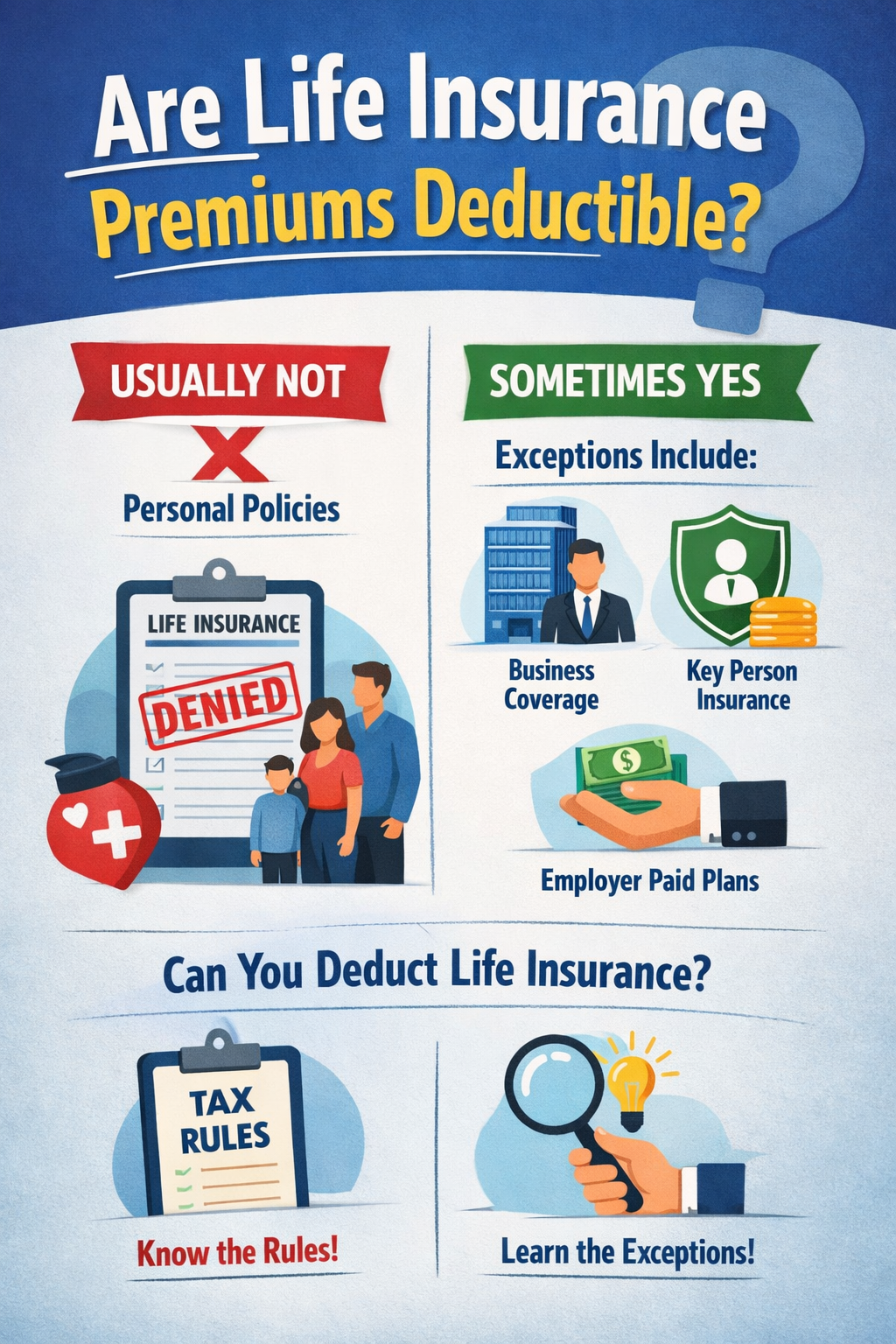
For most people, life insurance premiums are not tax deductible. That is the clean answer. The confusion starts when business use, group-term employee benefits, key person coverage, and other special situations enter the picture.
This guide keeps the deduction question simple. It explains when premiums are usually not deductible, where the real business exceptions show up, and how to think about personal, self-employed, employer-paid, and business-owned coverage the right way.

Scott Benton (a.k.a. Coach B.)
Author: Scott Benton, Licensed Life Insurance Agent (Coach B. Insurance)
Experience: Serving families since 1992
Disclosure: Coach B. Insurance may be compensated if you purchase through our agency. Recommendations are based on fit, underwriting, and clarity — not pressure.
Editorial note: This page is educational, not tax advice. Business, employer, divorce, and ownership-structure questions should be reviewed with a qualified tax professional.
- Are personal life insurance premiums deductible?
- Can a business deduct life insurance premiums?
- Are key person premiums deductible?
- Is employer-paid group term deductible?
- How is this different from “is life insurance taxable”?
Short Answer: Are Life Insurance Premiums Deductible?
Usually, no. If you buy life insurance for yourself or your family, the premiums are generally treated as a personal expense, not a tax deduction.
The confusion usually comes from business and employer scenarios, where the answer can change depending on who owns the policy, who benefits from the death benefit, and whether the coverage is being offered as an employee benefit.
Clean rule of thumb
- Personal policy for your family = usually not deductible
- Business-owned policy where business benefits = usually not deductible
- Employer-paid employee benefit coverage = sometimes deductible to the business
- Deductible question is separate from taxable-payout question
Deductible vs Not Deductible: The Simple Table
| Scenario | Usually Deductible? | Why |
|---|---|---|
| Personal term life for your family | No | Usually treated as a personal expense |
| Personal whole or universal life | No | Usually treated the same as other personal life insurance premiums |
| Business-owned policy where business is beneficiary | Usually no | The business benefits directly from the death benefit |
| Employer-paid group-term life as an employee benefit | Often yes to the business | Usually treated as an employee benefit expense |
| Self-employed person trying to deduct personal life insurance | Usually no | Life insurance is not usually treated like self-employed health insurance |
| Rare divorce / alimony-related setups | Sometimes technical | Very fact-specific and usually needs professional review |
Personal Life Insurance: Usually Not Deductible
If you buy life insurance to protect your spouse, children, mortgage, or general family finances, the premium is usually not deductible. That applies whether the policy is term life, whole life, or another personal policy type.
In everyday planning, life insurance is usually treated more like a personal financial protection tool than a deductible expense.
Common non-deductible examples
- Term life for income replacement
- Whole life for family protection
- Mortgage-related family coverage
- Personal permanent policies
Business Use: Where the Confusion Starts
Businesses often assume life insurance premiums should be deductible because the policy is business-related. But the key question is not just who pays the premium. The key question is who benefits from the death benefit.
If the business is directly or indirectly the beneficiary, the premium is usually not deductible.
Key concept
- Who owns the policy matters
- Who receives the death benefit matters even more
- Business-related does not automatically mean deductible
Are Key Person Life Insurance Premiums Deductible?
Usually no, if the business is the beneficiary. That is why key person life insurance often creates confusion. It is clearly business-related, but the business is also the party protected by the death benefit.
So even though key person coverage is often smart business planning, that does not automatically make the premium deductible.
Use the key person page if you need
- What key person insurance is
- Who should be covered
- How much coverage a business may need
- How it differs from buy-sell and SBA loan coverage
Are Buy-Sell Agreement Premiums Deductible?
Usually not in many common structures, because the people or entities involved are also the ones that benefit from the policy. That is why buy-sell planning is usually more about succession funding than premium deduction.
The agreement may be smart. The funding may be necessary. But that does not mean the premium is automatically deductible.
Use the buy-sell page if you need
- Cross-purchase vs entity purchase
- How life insurance funds an ownership buyout
- What happens if the agreement is unfunded
Are SBA Loan Life Insurance Premiums Deductible?
Sometimes people assume lender-required life insurance should be deductible because the loan requires it. But the deduction question still depends on ownership, beneficiary structure, and who is protected by the policy.
If the structure is business-protection oriented, deduction limits often still apply. The fact that the lender required the coverage does not automatically make the premium deductible.
Use the SBA page if you need
- When SBA lenders require life insurance
- How much coverage may be needed
- How collateral assignment works
Employer-Paid Group Term Life: The Most Common “Maybe Yes” Lane
Employer-paid group term life insurance is one of the main situations where the business side of the answer can be different. When coverage is provided as an employee benefit, the employer may often treat the premium as part of the cost of providing employee benefits.
That does not make every life insurance premium deductible. It just means this is one of the clearest employer-benefit exceptions people run into.
Why this lane is different
- It is an employee benefit context
- The business is not using it the same way as key person coverage
- The tax handling can differ from business-owned beneficiary situations
Need the Right Structure, Not Just the Right Policy?
A tax question is often really a structure question. Who owns the policy, who pays, who benefits, and why the policy exists usually matter more than the product name alone.
Self-Employed: Can You Deduct Personal Life Insurance?
This is one of the most common misunderstandings. Many self-employed people know there are special tax rules for some types of insurance, so they assume life insurance works the same way.
Usually it does not. Personal life insurance is still usually treated as a personal expense, even when the person buying it is self-employed.
Simple answer
- Self-employed does not automatically change the life insurance rule
- Personal life insurance is still usually not deductible
- Do not confuse this with health insurance deduction rules
Decision Tool: Can I Deduct My Life Insurance Premiums?
1. Is this personal family coverage?
If yes, the answer is usually no.
2. Is a business paying the premium?
That alone does not settle it. You still need to ask who benefits from the death benefit.
3. Is the business directly or indirectly beneficiary?
If yes, deduction limits usually still matter.
4. Is this an employee-benefit setup?
If yes, this is one of the more common lanes where the business side may be different.
This Page vs “Is Life Insurance Taxable?”
These are not the same question.
This page is about whether the premium can be deducted when you pay it. The taxable page is about whether the death benefit, cash value access, or other policy-related amounts may be taxable.
Use the taxable page if you need
- Whether a death benefit is taxable
- Whether cash value access can trigger taxes
- Whether policy proceeds are tax free
Helpful Next Pages
Is Life Insurance Taxable?
Best next page if your question is about taxation of proceeds or benefits rather than deducting the premium.
Explore Taxable Guide →Key Person Life Insurance
Best next page if your deduction question is tied to business-owned coverage on a key owner or employee.
Explore Key Person Guide →Funding a Buy-Sell Agreement
Best next page if your deduction question is tied to succession planning between business owners.
Explore Buy-Sell Guide →SBA Loan Life Insurance
Best next page if the life insurance exists because a lender or SBA loan requires it.
Explore SBA Loan Guide →Frequently Asked Questions About Deducting Life Insurance Premiums
Are life insurance premiums tax deductible for individuals?
Usually no. Personal life insurance premiums are generally treated as a personal expense.
Are life insurance premiums deductible for the self-employed?
Usually not when the policy is personal life insurance. Self-employed status does not usually change that basic rule.
Are key person life insurance premiums deductible?
Usually not when the business is directly or indirectly the beneficiary of the policy.
Is employer-paid life insurance deductible?
In some employee-benefit contexts, it may be deductible to the business as part of providing employee benefits.
Is this the same as asking whether life insurance is taxable?
No. Deductibility asks whether the premium can be written off when paid. Taxability asks whether policy proceeds or related amounts can be taxed later.


