
What Disqualifies a Life Insurance Payout? Why Claims Get Denied or Delayed
Most life insurance policies do pay when the policy is active and the original application was accurate. But there are specific situations that can delay, challenge, or disqualify a payout.
This page explains the most common claim-denial triggers, what the contestability period actually means, what usually does not stop a payout, and how to reduce the risk of claim problems later.

Scott Benton (a.k.a. Coach B.)
Author: Scott Benton, Licensed Life Insurance Agent (Coach B. Insurance)
Experience: Serving families since 1992
Disclosure: Coach B. Insurance may be compensated if you purchase through our agency. Recommendations are based on fit, underwriting, and clarity — not pressure.
Editorial note: This page is educational. Claim handling, lapse rules, contestability procedures, and beneficiary requirements can vary by policy form, carrier, and state.
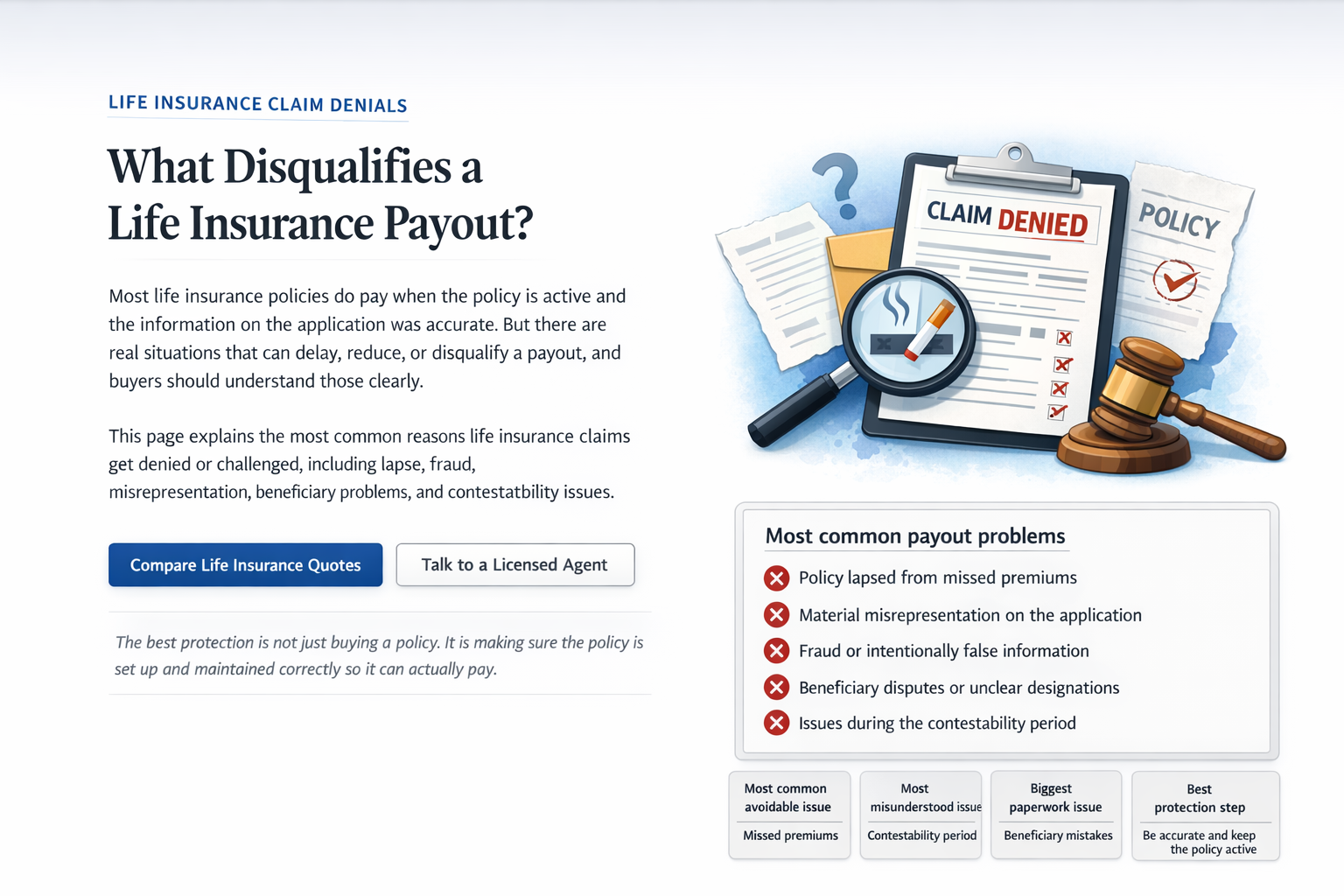
- Policy lapse from missed premiums
- Material misrepresentation
- Fraud or intentional false information
- Beneficiary disputes or errors
- Contestability-period investigation issues
Short Answer: What Can Disqualify a Life Insurance Payout?
A life insurance payout can be denied or challenged when the policy was no longer active, when material information used to issue the policy was inaccurate, or when beneficiary or legal issues prevent the insurer from paying cleanly.
In plain English, the biggest risks usually come down to three buckets: the policy lapsed, the application was materially inaccurate, or the payout instructions are disputed or unclear.
Direct answer
- Policy lapse
- Fraud or intentional misrepresentation
- Material health or tobacco misstatements
- Beneficiary disputes or confusion
- Contestability-period investigation issues
Most Common Reasons Life Insurance Claims Get Denied
Policy lapse
If premiums were not paid and the policy was no longer in force, there may be no death benefit to pay.
Material misrepresentation
If important health, tobacco, or other underwriting facts were misstated, the claim can be challenged.
Fraud
Intentional false information creates one of the clearest claim-denial triggers.
Beneficiary problems
Outdated, unclear, or disputed beneficiary designations can complicate or delay payment.
Contestability issues
If death happens early in the policy and there are inconsistencies, the insurer may investigate more closely.
Paperwork disputes
Sometimes the issue is not fraud or lapse, but conflicting instructions or legal questions around who should receive the benefit.
Missed Premiums and Policy Lapse
One of the most common and most avoidable reasons a payout may fail is policy lapse. If the policy owner stops paying premiums and the policy is no longer active, the insurer may have no death benefit in force to pay.
This is why affordability matters so much. A policy only helps if it stays active long enough to do its job.
How to reduce lapse risk
- Choose a premium you can realistically keep
- Use reminders or autopay when appropriate
- Review affordability after life changes
- Do not ignore lapse or grace-period notices
Material Misrepresentation on the Application
A life insurance application needs accurate information. If an applicant leaves out or changes important facts about health history, tobacco use, medications, or other underwriting questions, the insurer may later investigate whether that information changed the decision to issue the policy or the rate offered.
Not every small mistake causes a denial, but a material misrepresentation can create real claim problems, especially if the death occurs early in the policy.
Examples of material issues
- Not disclosing smoking or nicotine use
- Leaving out major health conditions
- Not reporting relevant medications
- Giving inaccurate answers about medical history
What Is the Contestability Period?
The contestability period is the early period after a policy is issued when the insurer may review the application more closely if the insured dies and something appears inconsistent.
Many people misunderstand this. It does not mean a claim automatically fails during that time. It means the insurer has a stronger window to investigate whether the application was truthful and complete.
What it usually means
- Claims may be reviewed more carefully early on
- Application accuracy matters a lot
- Not every claim is denied
- Clear, honest answers reduce risk
Want to Reduce the Risk of Future Claim Problems?
The best protection is not just buying a policy. It is making sure the policy is active, affordable, accurately set up, and still fits your family situation over time.
Beneficiary Problems That Can Delay or Complicate a Claim
Outdated beneficiary
After divorce, remarriage, or family changes, old designations may no longer match what the policy owner intended.
No contingent beneficiary
If the primary beneficiary cannot receive the money and there is no backup listed, the claim can get more complicated.
Minor-child issues
Naming a minor directly can create handling problems depending on how the funds must legally be managed.
Best next page for this issue: Life Insurance Beneficiaries →
What Usually Does Not Disqualify a Life Insurance Payout?
A normal valid claim
Most policies do pay when the policy is active and the application was accurate.
Death happening early by itself
Early death does not automatically mean denial. It may mean closer review, not automatic nonpayment.
An investigation alone
Investigation does not automatically mean the claim will fail.
Properly disclosed health issues
If the application was honest and the policy was issued accordingly, disclosed health issues alone do not usually block payment.
Denied Claim vs Delayed Claim
Some people search for “what disqualifies a payout” when the problem is not a denial yet. Sometimes the claim is simply still being reviewed because documents are missing, the beneficiary designation is unclear, or the insurer is verifying details.
That is why it helps to separate the filing process from actual denial triggers.
Use the claim-process page if you need
- How to file a claim
- What documents are usually needed
- What the normal claim timeline looks like
- What beneficiaries should do first
How to Reduce the Risk of a Claim Problem
Answer accurately
Clear, honest application answers reduce contestability and misrepresentation issues later.
Keep the policy active
Affordable coverage and consistent premium payment reduce lapse risk.
Review beneficiaries
Update designations after marriage, divorce, children, or other major life changes.
Understand the policy
Basic awareness of claim handling, grace periods, and policy setup helps avoid preventable surprises.
Helpful Next Pages
Life Insurance Claim Process
Use this if you need the neutral step-by-step claim guide rather than denial reasons.
Open Claim Guide →Denied Life Insurance Router
Use this if you are trying to sort out whether the problem is an application denial or a claim denial.
Open Denied Life Insurance Router →Life Insurance Beneficiaries
Use this if your concern is beneficiary setup, updates, or payout confusion after life changes.
Open Beneficiaries Guide →Frequently Asked Questions About Life Insurance Payout Denials
What disqualifies a life insurance payout?
Common reasons include policy lapse, fraud, material misrepresentation on the application, beneficiary problems, and issues uncovered during the contestability period.
Can a life insurance claim be denied for missed premiums?
Yes. If the policy lapsed because premiums were not paid and coverage was no longer active, there may be no death benefit in force to pay.
What is the contestability period in life insurance?
It is the early period after the policy is issued when the insurer may investigate the application more closely if the insured dies and there is reason to question the information provided.
Can beneficiary mistakes delay a payout?
Yes. Outdated, unclear, or disputed beneficiary designations can delay or complicate the claim process.
Do most life insurance policies actually pay?
In most ordinary situations, yes. When the policy is active and the application information was accurate, a valid claim usually pays as intended.
Avoidable Mistakes Cause Most Preventable Claim Problems
The goal is not to make people fear life insurance. It is to help families avoid the small number of preventable mistakes that cause the biggest payout issues later.


