
Universal Life Insurance Cost: What You’ll Pay, Why It Changes, and How to Estimate It
Universal life insurance cost is not one fixed number. It is a moving target based on your age, health, coverage amount, policy design, and how the policy is funded over time.
That is why universal life often feels more complicated than term life. You are not just paying for a death benefit. You are also dealing with internal insurance costs, policy charges, and the cash value side of the contract.
This page is built to help you understand what universal life insurance really costs, what drives the monthly premium, how the “bucket” model works, and when GUL or another type of permanent coverage may be the better fit.
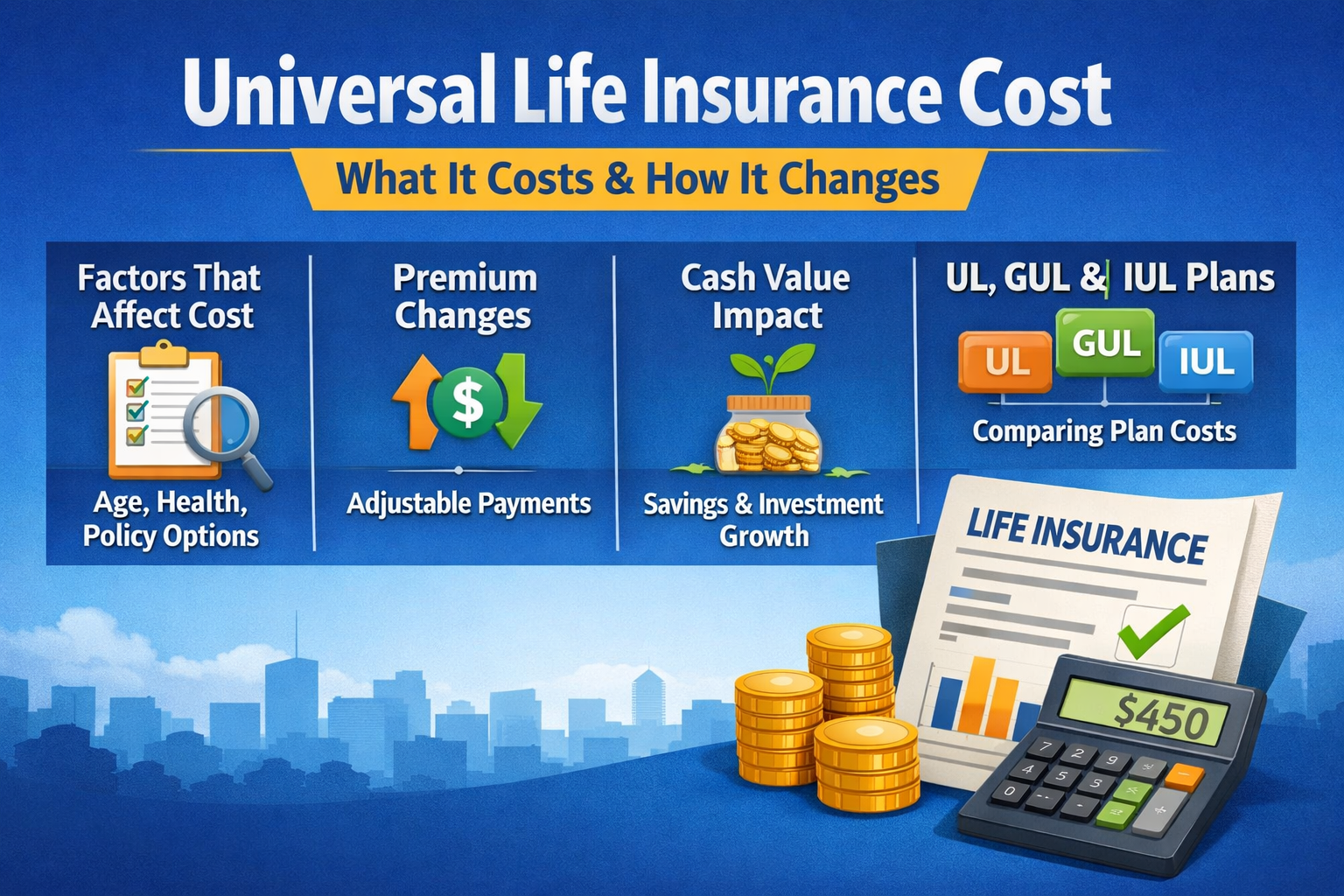
- Why universal life costs more than term
- What makes the premium go up or down
- How cash value and COI affect long-term cost
- Whether GUL is the better fit
- How to estimate a realistic monthly range
Why Universal Life Insurance Cost Is Different Than Term Life
Universal life is permanent insurance. That means it is designed to stay in force for life as long as the policy is funded well enough to support its internal costs.
Term life is simpler. You pay for coverage during a set period of time. Universal life is different because the policy has moving parts:
- cost of insurance charges
- policy fees and loads
- cash value accumulation
- flexible funding mechanics
That flexibility can be valuable, but it also means the long-term cost picture is more complicated than just looking at the first premium number.
The Biggest Cost Drivers
Age
Age is one of the biggest pricing levers. Older issue ages usually mean higher cost of insurance charges.
Health
Your underwriting class affects how expensive the policy is to maintain from the start.
Tobacco or nicotine
Nicotine use is often one of the largest cost jumps in universal life pricing.
Death benefit amount
More coverage usually means higher premium requirements and higher long-term funding needs.
Fees and charges
Monthly policy charges and other internal costs reduce what stays in the policy.
Funding strategy
A minimally funded policy can become fragile later if rising costs start draining cash value.
The Bucket Model: Why Universal Life Can Get More Expensive Later
The easiest way to understand universal life cost is to picture the policy like a bucket.
- Your premium goes into the bucket.
- The insurer takes out cost of insurance and policy charges.
- What stays in the bucket becomes cash value.
- If what comes out is more than what goes in, the policy starts pulling from cash value.
- If the bucket gets drained too far, the policy may need more premium or it can become unstable.
Coffee takeaway
Universal life cost is not just the starting premium. The real cost is whether the policy stays funded well enough to keep the bucket healthy over time.
Universal Life Insurance Cost Per Month: Very General Planning Ranges
There is no one true “average” monthly universal life premium. These are rough planning ranges to help you understand the ballpark before you shop.
These are broad ranges only. Traditional UL, GUL, IUL, tobacco status, underwriting class, and carrier pricing can move the real number a lot.
UL vs. GUL vs. IUL: What You’re Really Paying For
A simple rule: if your main goal is a lifetime death benefit with the least long-term drama, GUL is often the cleaner fit than a minimally funded cash-value UL.
Simple Universal Life Insurance Cost Estimator
This is not a carrier quote. It is a practical way to estimate your likely monthly band before you shop.
Step 1: Start with a base monthly band
Use the age and face amount table above as your starting point.
Step 2: Apply the big modifiers
Estimated Monthly Range = Base Range × Tobacco Factor × Health Factor × Design Factor
- Tobacco factor: non-tobacco about 1.0, tobacco often 1.5–2.5+
- Health factor: excellent may lower cost, multiple conditions usually raise it
- Design factor: GUL, UL, and IUL can each land differently depending on design and goals
Example
Age 45, $500k, non-tobacco, average health, traditional UL: start with the 40s / $500k band, then adjust if health, nicotine, or design makes the case stronger or weaker.
How to Lower Universal Life Insurance Cost Legitimately
Choose the right type
Do not pay for complexity you do not need.
Improve underwriting
Better blood pressure, weight, and stability can help.
Avoid nicotine
This is often one of the biggest cost multipliers.
Right-size the face amount
Buy enough coverage, but not a number that overshoots the actual need.
Review annually
Universal life should be monitored, not forgotten.
Who Should Consider Universal Life Insurance?
Usually a better fit if you:
- want lifetime coverage
- are comfortable with more product complexity
- value flexibility in funding
- are willing to review the policy over time
- have a long-term planning use for permanent insurance
Usually not the best fit if you:
- just need temporary income-replacement coverage
- want the simplest low-cost structure possible
- do not want to monitor a policy over time
- prefer stronger guarantees over flexibility
Universal Life Can Work Well — But Only If the Funding Matches the Design
That is the real cost lesson most buyers miss.
Universal life is not automatically bad and it is not automatically too expensive. The problem usually shows up when a policy is bought with the wrong expectations or funded too lightly for too long.
Helpful Related Pages
Universal Life Guide
Best next page if you want the broader product overview before focusing only on cost.
Explore Universal Life →Life Insurance Cost Guide
Best next page if you want to compare universal life cost against other major policy types.
Compare Life Insurance Costs →Whole Life
Best next page if you want to compare universal life against a more guarantee-driven permanent option.
Explore Whole Life →Term Life
Best next page if you are really trying to decide whether permanent coverage is necessary at all.
Explore Term Life →Frequently Asked Questions About Universal Life Insurance Cost
How much does universal life insurance cost per month?
It depends on age, health, nicotine use, death benefit amount, policy type, and how the policy is funded over time.
Why is universal life insurance more expensive than term?
Because it is permanent insurance with cash value mechanics and internal policy charges, not just temporary pure death-benefit coverage.
Can universal life premiums increase?
The funding need can rise over time if policy charges grow and the policy is not funded strongly enough to keep up.
What is the cheapest way to get lifetime coverage?
For buyers focused mainly on lifetime death-benefit coverage with more predictable funding, GUL is often the cleaner comparison point.
How do I know if universal life is right for me?
It is usually a better fit when you want permanent coverage, can handle more product complexity, and are willing to review the policy over time.


