
Life Insurance With Depression: Can You Qualify and What Will It Cost?
Yes, many people with depression can still qualify for life insurance. The bigger issue is usually how the condition is being managed, whether treatment is stable, and what the rest of the medical and mental health history looks like.
This page explains how insurers look at depression, how medication and therapy may affect underwriting, what usually matters most in approval and pricing, and which life insurance options may fit best.

Scott Benton (a.k.a. Coach B.)
Author: Scott Benton, Licensed Life Insurance Agent (Coach B. Insurance)
Experience: Serving families since 1992
Disclosure: Coach B. Insurance may be compensated if you purchase through our agency. Recommendations are based on fit, underwriting, and clarity — not pressure.
Editorial note: This article is educational. Underwriting rules, mental health history review, medication treatment, and life insurance rates vary by carrier, product, and state.
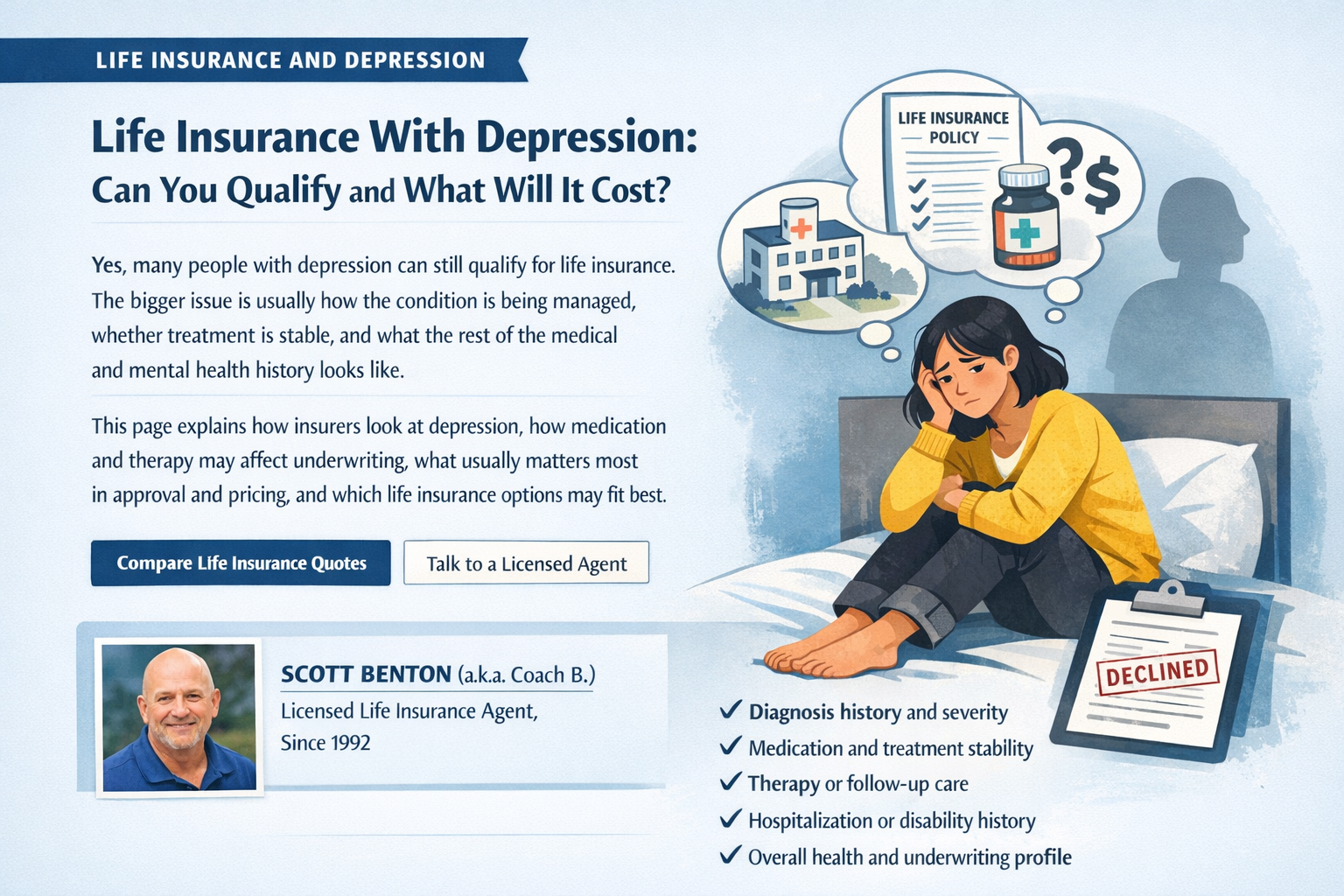
- Diagnosis history and severity
- Medication and treatment stability
- Therapy or follow-up care
- Hospitalization or disability history
- Overall health and underwriting profile
Can You Get Life Insurance With Depression?
Yes. Many people with depression can still get life insurance. In many cases, the diagnosis alone does not disqualify someone. What matters more is how serious the condition is, whether it is being treated, whether the condition is stable, and whether there are other related medical or mental health concerns.
An applicant with a long, stable history and consistent treatment may be viewed much differently than someone with a recent diagnosis, frequent medication changes, disability leave, or more serious episodes.
Direct answer
- Yes, many applicants can still qualify
- Stable treatment history often helps
- Medication is not automatically a problem
- Carrier choice can make a real difference
Why Depression Matters in Life Insurance Underwriting
Severity matters
Mild, moderate, and more serious depression histories may be viewed differently depending on the insurer and overall profile.
Stability matters
A stable condition with consistent treatment is often viewed differently than a recent, changing, or unmanaged situation.
Context matters too
Anxiety, substance use history, disability leave, hospitalization, and other health concerns may affect the final outcome.
Do Antidepressants Hurt Your Chances?
Usually, taking medication for depression is not the problem by itself. In many cases, treatment can actually help show that the condition is being managed responsibly. What matters more is whether the treatment appears stable, how many medications are involved, and whether symptoms are controlled.
Frequent recent medication changes may raise more underwriting questions than a long period of steady treatment.
Medication may be viewed more favorably when:
- The treatment plan is stable
- There is consistent follow-up care
- There are no major recent episodes
- The rest of the health picture is solid
What Else Insurers May Look At Besides the Diagnosis
| Factor | Why It Matters | General Impact |
|---|---|---|
| How long ago you were diagnosed | Longer stable history may look different than a recent diagnosis | Can affect confidence in stability |
| Medication stability | Frequent recent changes may raise more underwriting questions | Stable treatment is often viewed better |
| Therapy or follow-up care | Ongoing care can show the condition is being managed | May support a stronger overall picture |
| Hospitalization or disability history | More serious history can create additional underwriting concern | May affect rate class or carrier fit |
| Other health or mental health issues | Anxiety, substance history, tobacco use, and medical conditions can all matter | The full profile matters more than one issue alone |
How Depression May Affect Life Insurance Rates
Mild and stable history
In some cases, applicants with mild or well-managed depression may still qualify for decent pricing depending on the rest of the health picture.
Moderate but controlled history
May lead to a less favorable class than ideal, but often still insurable with the right carrier.
Recent, severe, or more complex history
Can create more underwriting concern and make carrier selection even more important.
Best Life Insurance Options With Depression
Term life insurance
For many people, term life is the strongest starting point because it often gives more coverage for less premium than permanent products.
Explore Term Life Insurance →No medical exam life insurance
No-exam options may be worth exploring in some cases, though underwriting style and pricing can vary a lot from one product to another.
Explore No Exam Coverage →Whole life insurance
Whole life may fit some long-term planning situations, though many people still start with term when cost matters more.
Explore Whole Life Insurance →How to Shop Smarter With Depression History
Know your treatment history
Dates, medications, and stability matter more than vague memory.
Be accurate on the application
Do not minimize mental health history. Clear answers help avoid future problems.
Compare more than one carrier
Different insurers may view the same depression history differently.
Look at the full health picture
Age, tobacco use, blood pressure, and other conditions still matter too.
Want Help Finding Life Insurance With Depression?
Compare quotes online or schedule a strategy call if you want help matching your depression history, treatment status, age, and budget to the right coverage options.
Helpful Related Pages
Life Insurance With Sleep Apnea
Best next page if sleep apnea is also part of your underwriting picture.
Explore Sleep Apnea Guide →Life Insurance With High Blood Pressure
Best next page if blood pressure is also part of your health profile.
Explore High Blood Pressure Guide →Life Insurance for Smokers
Best next page if tobacco use is also part of the underwriting picture.
Explore Smokers Guide →Term Life Insurance Rates by Age
Best next page if you want to compare age-driven pricing alongside medical concerns.
Explore Rates by Age →Frequently Asked Questions About Life Insurance With Depression
Can you get life insurance with depression?
Yes. Many people with depression can still qualify for life insurance, especially when the condition is treated and the overall profile appears stable.
Do antidepressants hurt life insurance approval?
Usually not by themselves. In many cases, treatment can actually help show that the condition is being managed responsibly.
Does depression always mean higher life insurance rates?
Not always at the same level. The rate impact depends on severity, treatment stability, recent history, and the insurer’s underwriting rules.
Is term life insurance a good option with depression?
For many people, yes. Term life is often the strongest starting point because it can provide more coverage for less premium than permanent options.
What matters most besides the diagnosis itself?
Insurers also look at treatment, stability, hospitalization history, disability history, tobacco use, other health conditions, and the overall underwriting profile.


