
Life Insurance for Non-U.S. Citizens: Eligibility, Documents, and Best Options
Yes, many non-U.S. citizens can qualify for life insurance in the United States. But approval usually depends on residency status, visa type, time spent in the U.S., identification documents, and how each insurer handles foreign-national underwriting.
That is why this page matters. Most people are not asking a general life insurance question. They are trying to figure out whether being a green card holder, visa holder, ITIN user, or non-resident with U.S. ties changes what kind of coverage they can actually get.
The real question is not just whether a non-U.S. citizen can buy life insurance. The real question is which residency or immigration situations are easiest, what documents carriers usually want, and what travel or U.S. ties may affect approval.
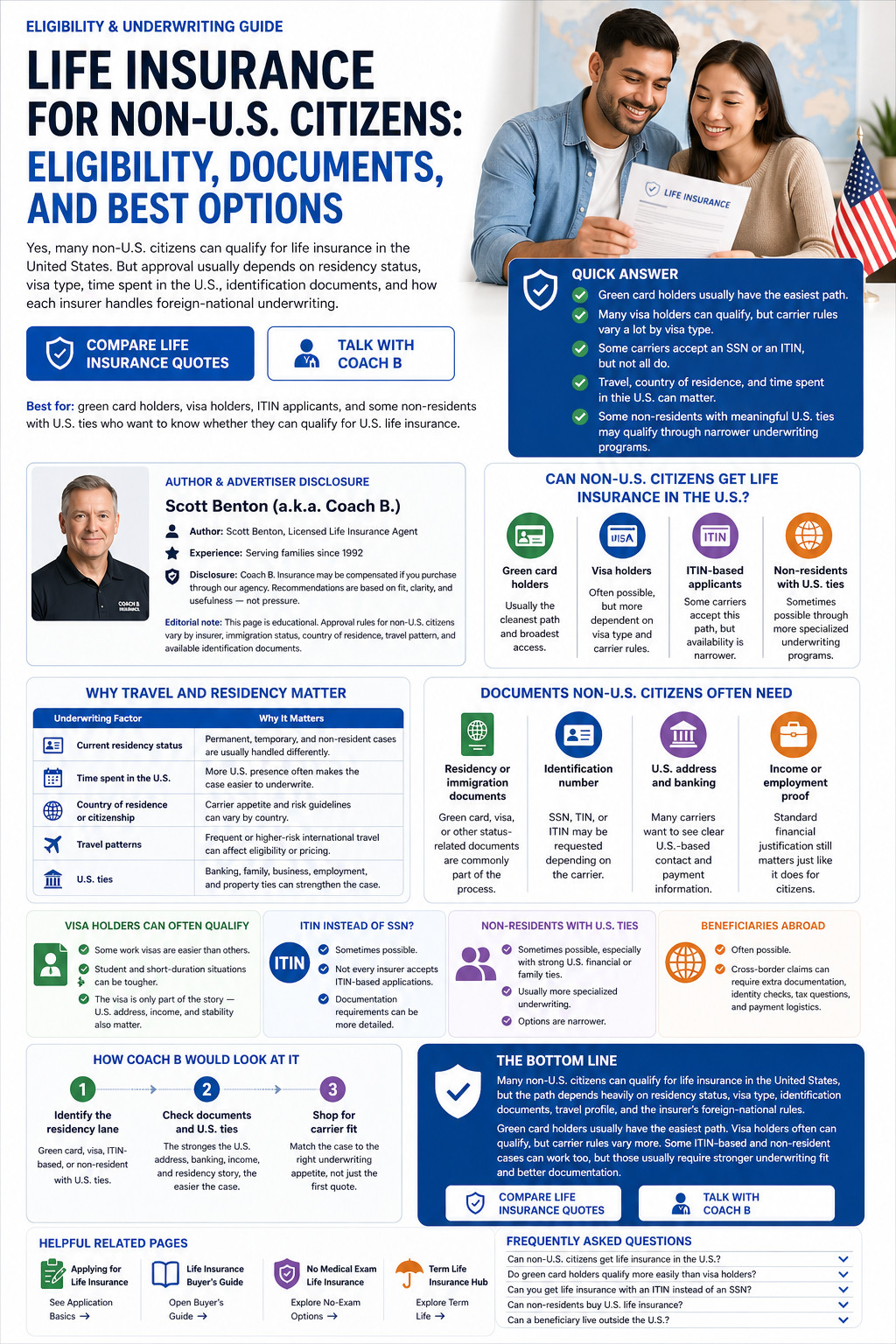
- Green card holders usually have the easiest path.
- Many visa holders can qualify, but carrier rules vary a lot by visa type.
- Some carriers accept an SSN or an ITIN, but not all do.
- Travel, country of residence, and time spent in the U.S. can matter.
- Some non-residents with meaningful U.S. ties may qualify through narrower underwriting programs.

Scott Benton (a.k.a. Coach B.)
Author: Scott Benton, Licensed Life Insurance Agent
Experience: Serving families since 1992
Disclosure: Coach B. Insurance may be compensated if you purchase through our agency. Recommendations are based on fit, clarity, and usefulness — not pressure.
Editorial note: This page is educational. Approval rules for non-U.S. citizens vary by insurer, immigration status, country of residence, travel pattern, and available identification documents.
Can Non-U.S. Citizens Get Life Insurance in the U.S.?
In many cases, yes. But “non-U.S. citizen” covers several very different underwriting categories, and carriers do not treat them all the same.
Green card holders
Usually the cleanest path and often the broadest access to standard products.
Visa holders
Often possible, but more dependent on visa type, U.S. residency, and carrier guidelines.
ITIN-based applicants
Some carriers accept this path, but documentation and availability can be narrower.
Non-residents with U.S. ties
Sometimes possible, usually through more specialized underwriting or carrier programs.
Green Card Holders Usually Have the Easiest Path
Why green card holders often do better
Permanent residency usually makes the underwriting story simpler because the applicant has a more stable U.S. presence, clearer long-term intent, and broader eligibility with many carriers.
What this usually means in real life
Green card holders often have the best chance of accessing standard term, whole life, and universal life options compared with more temporary residency categories.
Visa Holders Can Often Qualify, But Carrier Rules Matter
Some work visas are easier than others
Employment-based visa situations are often easier for carriers to evaluate than short-term or less stable cases.
Student and short-duration situations can be tougher
Temporary status, uncertain duration, or limited U.S. ties can narrow carrier options quickly.
The visa is only part of the story
Insurers often also look at U.S. address, banking, income, travel, and how long the applicant expects to stay in the country.
What About Applying With an ITIN Instead of an SSN?
Sometimes possible
Some carriers will accept an ITIN or other tax identification route when a Social Security number is not available.
But do not assume every insurer will
Identification requirements vary, which is why this topic is often more about finding the right carrier fit than just filling out an application.
The clean way to explain it
“No SSN” does not automatically mean “no life insurance,” but it usually means the list of workable carriers gets smaller and the documentation matters more.
Why Travel and Residency Matter So Much
| Underwriting Factor | Why It Matters |
|---|---|
| Current residency status | Permanent, temporary, and non-resident cases are usually handled differently. |
| Time spent in the U.S. | More U.S. presence often makes the case easier to underwrite. |
| Country of residence or citizenship | Carrier appetite and risk guidelines can vary by country. |
| Travel patterns | Frequent or higher-risk international travel can affect eligibility or pricing. |
| U.S. ties | Banking, family, business, employment, and property ties can strengthen the case. |
Documents Non-U.S. Citizen Applicants Often Need
Residency or immigration documents
Green card, visa, or other status-related documents are commonly part of the process.
Identification number
SSN, TIN, or ITIN may be requested depending on the carrier.
U.S. address and banking
Many carriers want to see clear U.S.-based contact and payment information.
Income or employment proof
Standard financial justification still matters just like it does for citizens.
Can Non-Residents Buy U.S. Life Insurance?
Sometimes, but this is the narrowest lane
Non-resident foreign nationals may qualify in some cases, especially when they have meaningful U.S. family, financial, or business ties.
This is usually more specialized
These cases are often handled by a smaller group of carriers or more specialized underwriting programs, especially for high-net-worth or U.S.-asset-based cases.
What About Beneficiaries Living Outside the U.S.?
Often possible
In many cases, a beneficiary living abroad can still be named on a U.S. life insurance policy.
But payment logistics may be less simple
Cross-border claims can involve extra documentation, identity checks, tax questions, and payment logistics depending on the carrier and location.
The practical takeaway
If the likely beneficiary lives outside the U.S., it is smart to ask about beneficiary documentation and claim-payment logistics before buying instead of assuming that part will be friction-free.
How Coach B Would Look at It
Step 1: identify the residency lane
Green card, visa, ITIN-based, or non-resident with U.S. ties — that is the first underwriting fork in the road.
Step 2: check documents and U.S. ties
The stronger the U.S. address, banking, income, and residency story, the easier the case usually is.
Step 3: shop for carrier fit
This is one of those topics where the best answer often comes from matching the case to the right underwriting appetite, not just chasing the first quote.
The Bottom Line
Many non-U.S. citizens can qualify for life insurance in the United States, but the path depends heavily on residency status, visa type, identification documents, travel profile, and the insurer’s foreign-national rules.
Green card holders usually have the easiest path. Visa holders often can qualify, but carrier rules vary more. Some ITIN-based and non-resident cases can work too, but those usually require stronger underwriting fit and better documentation.
Helpful Related Pages
Applying for Life Insurance
Best next page if you want the broader application process after understanding the foreign-national eligibility issues.
See Application Basics →Life Insurance Buyer’s Guide
Best next page if your bigger question is how to choose coverage amount, policy type, and next steps.
Open Buyer’s Guide →No Medical Exam Life Insurance
Best next page if you are comparing whether a faster underwriting path may be available in your situation.
Explore No-Exam Options →Term Life Insurance Hub
Best next page if you want the broader term-life guide after confirming you are likely eligible to apply.
Explore Term Life →Frequently Asked Questions
Can non-U.S. citizens get life insurance in the U.S.?
Yes, many can, but eligibility usually depends on residency status, visa type, documentation, travel profile, and carrier rules.
Do green card holders qualify more easily than visa holders?
Usually yes. Green card holders often have broader access and a simpler underwriting story than temporary visa holders.
Can you get life insurance with an ITIN instead of an SSN?
Sometimes. Some carriers accept ITIN-based applications, but not every insurer does.
Can non-residents buy U.S. life insurance?
Sometimes, especially when they have meaningful U.S. financial or family ties, but these cases are usually more specialized.
Can a beneficiary live outside the U.S.?
Often yes, but cross-border claim payment can involve extra documentation and logistics, so it is smart to ask about that before buying.


