
Final Expense Insurance Rates by Age: Sample Costs for Seniors
Final expense insurance rates usually rise with age, but age is only part of the story. Gender, coverage amount, tobacco use, health, and plan type all affect what you actually pay.
That is why this page matters. Most buyers searching for final expense insurance rates by age are not looking for a generic explanation. They want to know what burial coverage might cost at their age and how to stay in a stronger-value pricing lane.
This guide gives you sample monthly cost patterns for seniors, shows how rates usually change by age and coverage amount, and explains why the cheapest-looking policy is not always the smartest overall fit.
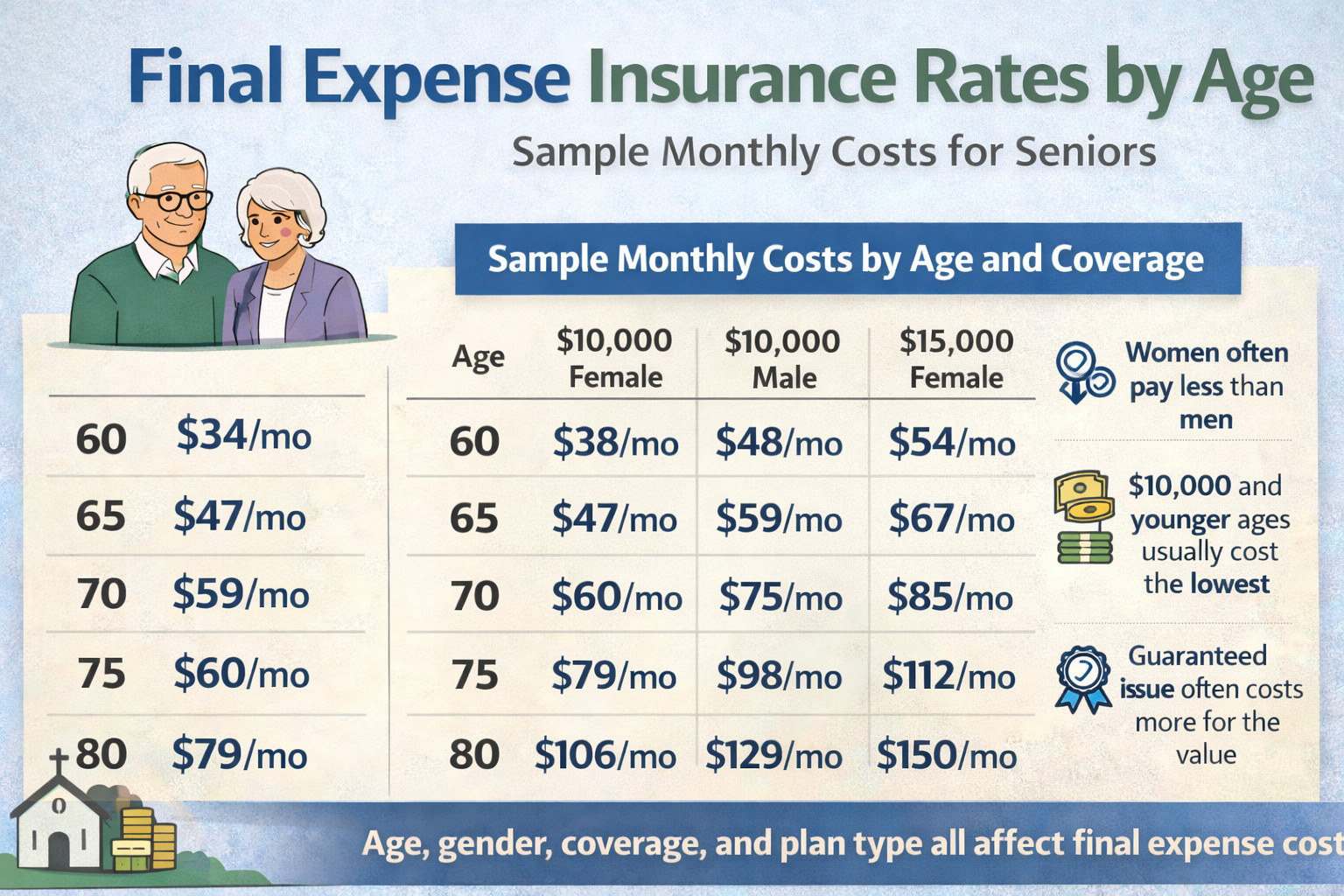
Final expense insurance usually gets more expensive as you get older. Women often pay less than men, smaller coverage amounts are usually cheaper, and stronger-value level benefit plans usually price better than weaker fallback options.
- Age is one of the biggest pricing factors
- $10,000 usually costs less than $15,000 or $20,000
- Men often pay more than women
- Guaranteed issue usually costs more for the value

Scott Benton (a.k.a. Coach B.)
Author: Scott Benton, Licensed Life Insurance Agent
Experience: Serving families since 1992
Disclosure: Coach B. Insurance may be compensated if you purchase through our agency. Recommendations are based on product fit, underwriting, clarity, and usefulness — not pressure.
Editorial note: The sample rates on this page are illustrative examples designed to show pricing patterns. Final quotes vary by age, sex, state, tobacco use, company, coverage amount, and whether you qualify for level benefit, graded benefit, or guaranteed issue.
How Age Affects Final Expense Insurance Rates
Age is one of the biggest drivers of final expense pricing because the older you are, the more likely the insurer believes it may need to pay a claim sooner.
That does not mean final expense insurance disappears later in life. It means the monthly premium usually moves up as you age, especially once you get into your 70s and 80s.
That is why many buyers get their best value by buying sooner rather than later, even if the coverage amount is modest.
Sample Monthly Rates by Age: $10,000 and $15,000 Coverage
These sample monthly rates are illustrative examples for non-tobacco applicants and are meant to show the pricing pattern by age rather than provide a guaranteed quote.
$10,000 vs $15,000 vs $20,000 Final Expense Coverage
Coverage amount matters almost as much as age. The more coverage you buy, the more you usually pay, although the relationship is not always perfectly linear.
For many buyers, $10,000 to $15,000 is the most practical affordability zone. Going higher can make sense, but it usually pushes monthly cost up fast at older issue ages.
Male vs Female Final Expense Rates
Why women often pay less
In many cases, women are priced lower than men at the same age and coverage amount. That is why sample charts often show female rates below male rates even when the face amount is identical.
What this means for shoppers
The right price comparison is not just age versus age. It is age, gender, coverage amount, and underwriting lane all together.
What Changes Rates Besides Age
Health profile
Your health history affects whether you qualify for a stronger-value level benefit policy or a weaker fallback lane.
Tobacco use
Tobacco can raise rates meaningfully and can change which carrier is most competitive.
Coverage amount
The more death benefit you buy, the more you usually pay each month.
Company rules
Some carriers price better at certain ages or for certain health profiles than others.
Plan type
Level benefit, graded benefit, and guaranteed issue are not priced the same because they do not offer the same value.
Why Guaranteed Issue Often Costs More for the Value
Easier approval is not free
Guaranteed issue is easier to qualify for, but that easier access usually comes with weaker value compared with stronger underwriting lanes.
Waiting periods matter
If a plan delays full natural-death benefits, the price has to be judged alongside that tradeoff, not just by the monthly premium alone.
The strongest-value rule
The best pricing move is usually to see whether you can still qualify for a stronger-value plan before assuming guaranteed issue is your only option.
Best Ages to Buy Final Expense Insurance
60s
Usually the best mix of affordability and easy access for many senior buyers.
Early 70s
Still often workable, but rates usually start climbing more noticeably.
Late 70s
Coverage is still available for many buyers, but price sensitivity becomes a much bigger issue.
80s and beyond
The right plan type matters more than ever because price rises and some coverage ceilings can get tighter.
Who This Page Fits Best
Seniors comparing budget ranges
This page works best for buyers trying to decide whether $10,000, $15,000, or $20,000 is the most realistic fit.
Families helping parents shop
It is also a strong page for adult children helping a parent understand likely monthly costs before asking for quotes.
Buyers choosing between policy lanes
If you are deciding whether final expense is more realistic than a larger policy, this is the right pricing page to start with.
The Bottom Line
Final expense insurance rates by age usually follow a simple pattern: the older you are, the more you usually pay. But age is only part of the quote.
Gender, tobacco use, coverage amount, company fit, and plan type all shape the real price. The smartest move is to use age-based sample rates to understand the pattern, then compare the right coverage amount and plan lane before you apply.
Helpful Related Pages
Final Expense Insurance
Best next page if you want the broader burial and final expense overview before narrowing to rates.
Explore Final Expense →Final Expense Insurance for Seniors
Best next page if you want the full senior buyer guide after looking at sample costs.
Open the Senior Guide →Cheap Burial Insurance
Best next page if your main question is how to keep monthly premiums as low as possible.
See Low-Cost Options →Burial Insurance With No Waiting Period
Best next page if immediate coverage timing matters more than just price.
See No-Waiting-Period Options →Final Expense Life Insurance Plan
Best next page if you need help understanding level benefit, graded benefit, and guaranteed issue pricing differences.
Compare Plan Types →Best Final Expense Insurance Companies for Seniors
Best next page if you want to compare the strongest companies after understanding what your age usually costs.
Compare Companies →Frequently Asked Questions
How much does final expense insurance cost by age?
Rates usually increase with age, but final price also depends on gender, tobacco use, coverage amount, company fit, and plan type.
Do women usually pay less than men for final expense insurance?
In many cases, yes. Women often have lower final expense rates than men at the same age and coverage amount.
What coverage amount is most common for final expense insurance?
For many buyers, $10,000 to $15,000 is one of the most common starting ranges because it balances affordability with useful burial and final-bill protection.
Why does guaranteed issue final expense often cost more?
Because easier approval usually comes with weaker value and often a waiting-period tradeoff compared with stronger underwriting lanes.
When is the best age to buy final expense insurance?
For many buyers, the 60s or early 70s offer a stronger mix of affordability and availability than waiting until later ages.


