
20 vs 30 Year Term Life Insurance: Which One Should You Choose?
A 20-year term life insurance policy can be a great fit when you want lower-cost protection for a defined period of time, but a 30-year term may make more sense when your family needs coverage for longer.
That is why this page matters. Buyers comparing 20 vs 30 year term life insurance are usually already past the “Do I need life insurance?” stage. They are trying to figure out which term length better matches their mortgage, their children’s ages, their income replacement needs, and their budget.
This guide breaks down the real difference between 20-year and 30-year term life insurance, what drives the cost difference, when each option can make sense, and when a different type of policy may be the better fit instead.
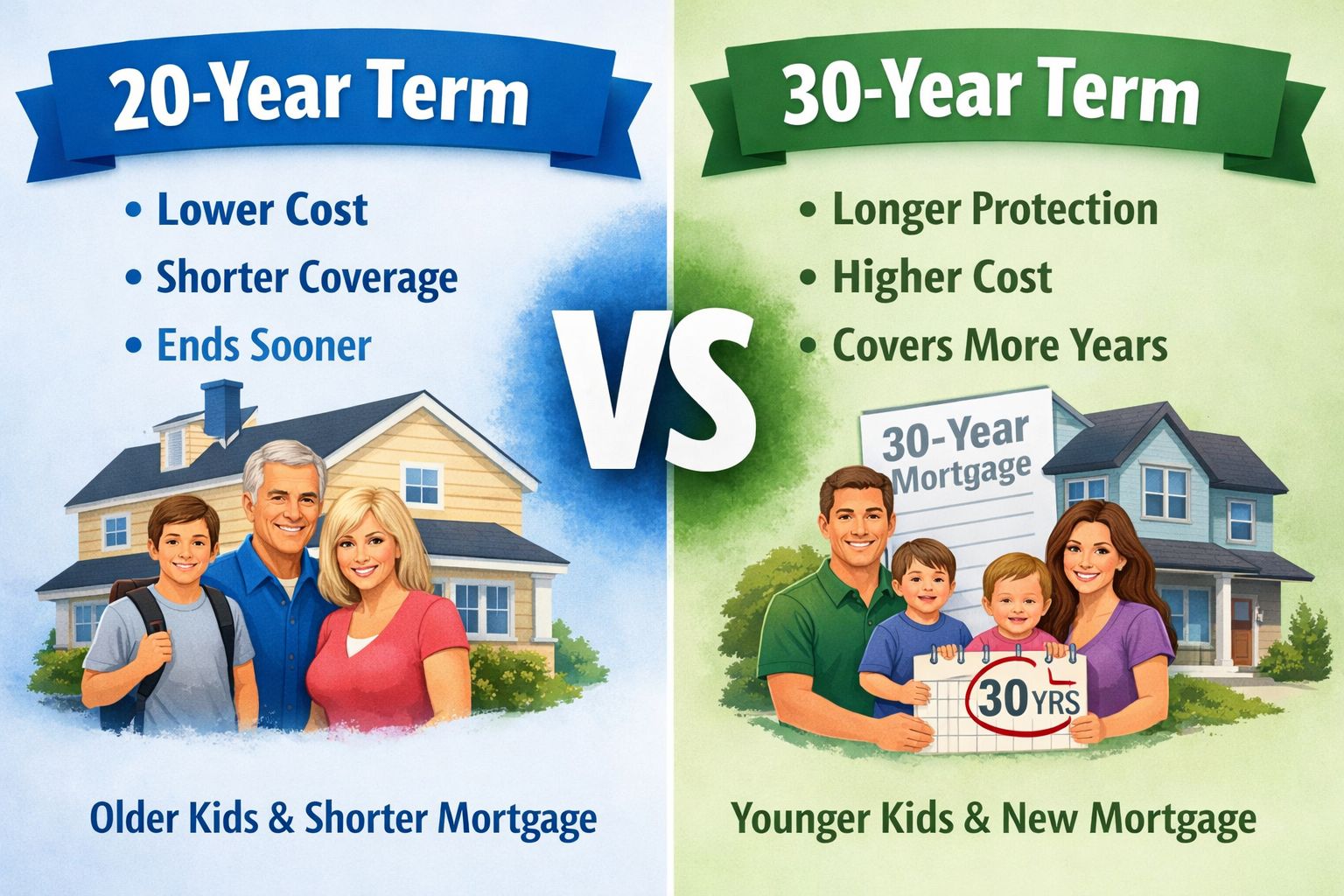
A 20-year term life insurance policy is usually the better fit when your biggest financial obligations will likely shrink within 20 years. A 30-year term life insurance policy is usually the better fit when you want a longer protection window for younger children, a newer mortgage, or a longer income replacement need.
- 20-year term = lower monthly cost
- 30-year term = longer protection
- Age and health still matter heavily
- The right choice depends on how long your family would actually need the coverage

Scott Benton (a.k.a. Coach B.)
Author: Scott Benton, Licensed Life Insurance Agent
Experience: Serving families since 1992
Disclosure: Coach B. Insurance may be compensated if you purchase through our agency. Recommendations are based on product fit, underwriting, clarity, and usefulness — not pressure.
Editorial note: Term life pricing depends heavily on age, health, sex, tobacco use, coverage amount, term length, and carrier underwriting. Planning comparisons are useful, but real quotes can vary.
What Choosing 20 vs 30 Year Term Is Really About
Choosing between a 20-year term and a 30-year term is usually not about finding the “best” policy in the abstract.
It is usually about matching your coverage length to your real financial responsibilities.
Common reasons people compare these two term lengths include:
- protecting a spouse and children during the working years
- covering a mortgage payoff timeline
- replacing income until children are financially independent
- locking in coverage now instead of trying to buy again later
20 vs 30 Year Term Life Insurance at a Glance
These are broad planning comparisons. Real quotes can vary by age, health, tobacco status, and company.
Why the Cost Changes
Age
Term life usually gets more expensive as you get older, which is one reason some buyers lock in a longer term earlier.
Health
Your underwriting class can move the monthly premium meaningfully for either term length.
Tobacco use
Smoking or nicotine use can push the cost much higher whether you are choosing 20 years or 30 years.
Term length
A 30-year term usually costs more because the insurer is covering you for an additional 10 years.
When a 20-Year Term Can Make Sense
Your biggest obligations may be behind you in 20 years
If your children will likely be grown, your mortgage mostly paid down, or retirement closer by then, a 20-year term can line up well.
You want a lower monthly premium
For many buyers, the 20-year term is the better budget fit while still covering the most important years.
You are buying coverage later in life
People in their 40s or 50s often find that a 20-year term gives strong protection without stretching the premium as much as a 30-year term.
When a 30-Year Term Can Make Sense
You have very young children
A 30-year term can keep protection in place through the full years your children depend on your income.
You recently started a long mortgage
If you took on a new 30-year mortgage, a 30-year term can match that timeline more closely.
You want to avoid buying coverage again later
Buying a longer term now can help avoid the risk of needing a new policy later when age and health may make it more expensive.
When It May Not Be the Best Fit
You are focusing only on the cheapest premium
The cheapest option is not always the right one. A 20-year term that ends too soon can create problems later.
You really need permanent coverage
If your goal is lifelong protection, estate planning, or permanent burial coverage, term life may not be the right category.
You are ignoring what happens after the term ends
The right choice is not just about the first monthly premium. It is also about whether the policy still fits your family when year 20 or year 30 arrives.
20 vs 30 Year Term vs Other Options
How to Decide Whether 20 or 30 Years Is the Right Length
20 years may be enough if you want:
- income protection until children are older
- coverage for a shorter debt timeline
- a better budget fit
- strong protection through your final working years
30 years may be better if you want:
- protection for a young family
- coverage that better matches a new mortgage
- longer income replacement security
- to lock in coverage now rather than buy again later
Common Mistakes People Make With Term Length
Choosing the shorter term only to save money now
That can backfire if the policy expires while your family still depends on the coverage.
Matching the term to age instead of obligations
The better question is not “How old will I be?” It is “How long will my family still need protection?”
Forgetting later coverage may cost more
Trying to buy another policy after 20 years often means older-age pricing and possibly more difficult underwriting.
Not comparing both term lengths side by side
Sometimes the premium difference is smaller than buyers expect relative to the value of the extra 10 years.
Ignoring the expiration problem
If the policy ends before your family no longer needs protection, the cheaper choice may not have been the better one.
The Bottom Line
A 20-year term life insurance policy can make sense when you want affordable protection and your biggest financial obligations will likely shrink within 20 years.
A 30-year term life insurance policy can make sense when you want longer protection for younger children, a long mortgage, or a bigger income replacement window.
The smartest move is to decide how long your family would actually need the protection, then compare the right term length instead of focusing only on the lowest premium.
Helpful Related Pages
Term Life Insurance
Best next page if you want the broader term life overview before choosing a specific term length.
Explore Term Life →Life Insurance for Income Replacement
Best next page if your main goal is making sure your family could replace your paycheck.
Read Income Replacement Guide →Term Life vs Mortgage Protection Insurance
Best next page if one of your biggest concerns is protecting the home loan.
Compare Mortgage Protection Options →How Much Life Insurance Do I Need?
Best next page if you are still trying to figure out how much coverage your family would really need.
Read Coverage Guide →Frequently Asked Questions
Is 20 or 30 year term life insurance better?
Neither is automatically better. A 20-year term is usually better for shorter financial obligations and a lower premium. A 30-year term is usually better for longer family or mortgage protection needs.
Is 30 year term life insurance much more expensive than 20 year term?
Usually yes, but the exact difference depends on your age, health, tobacco status, coverage amount, and the company you choose.
Should my term life insurance match my mortgage?
It can be a smart starting point, especially if paying off the home is one of your biggest goals. But you should also think about children, income replacement, and other financial obligations.
What happens if I outlive the term?
If you outlive the policy, the coverage ends unless you renew it, convert it, or buy a new policy if available.
Who should usually lean toward a 30-year term?
Buyers with very young children, long mortgage timelines, and a longer income replacement need often lean toward a 30-year term.


