
Guaranteed No-Lapse Universal Life Insurance: How It Works, Who It Fits, and What to Watch
Guaranteed no-lapse universal life insurance is permanent coverage built around one main promise: keeping the death benefit in force as long as required premiums are paid correctly.
That is why this page matters. Most shoppers are not just asking what no-lapse universal life is. They are trying to figure out whether the guarantee is real, how strict the payment rules are, whether there is meaningful cash value, and how it compares with whole life.
The real question is not just what guaranteed no-lapse universal life insurance means. The real question is whether you want permanent coverage built around guarantee efficiency instead of cash-value growth and flexibility.
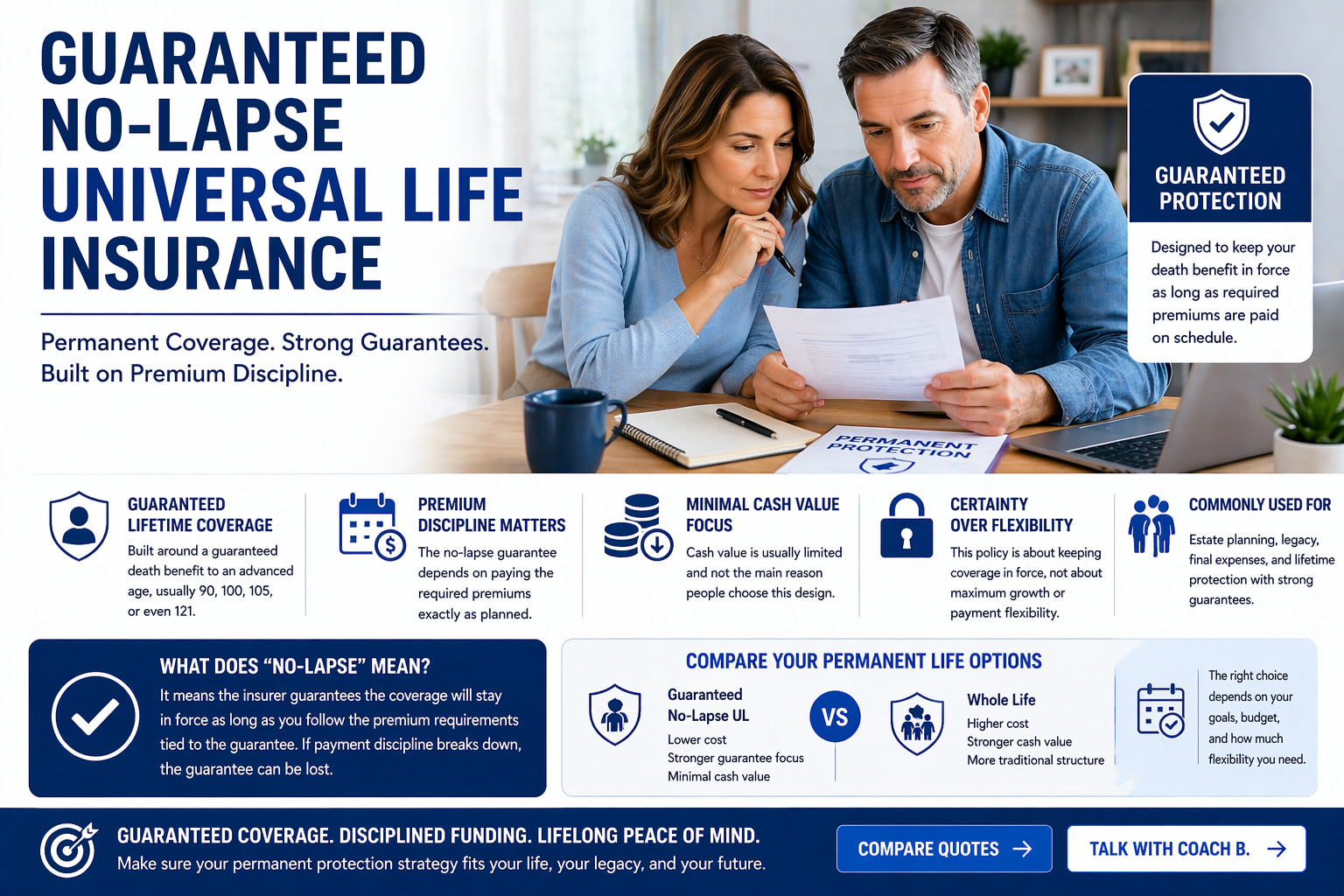
- It is permanent life insurance focused on a guaranteed death benefit.
- The no-lapse promise usually depends on meeting premium requirements exactly.
- Cash value is often minimal or secondary.
- It is commonly compared with whole life because both are permanent coverage.
- If payment discipline breaks, the guarantee can break too.

Scott Benton (a.k.a. Coach B.)
Author: Scott Benton, Licensed Life Insurance Agent
Experience: Serving families since 1992
Disclosure: Coach B. Insurance may be compensated if you purchase through our agency. Recommendations are based on fit, clarity, and usefulness — not pressure.
Editorial note: This page is the guaranteed no-lapse / GUL subtype guide. It is here to explain the guarantee structure clearly, not to treat all universal life policies like they work the same way.
What Guaranteed No-Lapse Universal Life Insurance Actually Is
Guaranteed no-lapse universal life is a form of permanent life insurance built mainly around keeping the death benefit in force, often to an advanced age, as long as required premiums are paid on schedule.
Permanent coverage
This is not temporary term insurance. It is designed as long-duration or lifetime-style coverage.
Guaranteed death benefit focus
The main selling point is the guarantee, not accumulation.
Minimal cash value emphasis
Cash value is usually secondary and often limited.
Strict funding discipline
The guarantee usually survives only when the premium rules are followed correctly.
What Does “No-Lapse” Really Mean?
What people think it means
Many buyers assume “no-lapse” means the policy can never fail no matter what happens inside the contract.
What it usually really means
It usually means the insurer guarantees the coverage stays active even if cash value is weak or minimal, as long as the premium requirements tied to the guarantee are met.
The key idea
The guarantee is the star of the policy. Cash value is not what is keeping this design alive the way people sometimes expect in other permanent-policy conversations.
How Guaranteed No-Lapse Universal Life Works in Plain English
You choose a death benefit
The coverage amount is set around long-term protection needs.
You agree to the premium structure
The premium plan is central because that is what supports the guarantee.
The insurer backs the guarantee
If the guarantee rules are satisfied, coverage is designed to remain in force.
Cash value stays secondary
This is usually not the policy for someone chasing growth or policy loans.
Guaranteed No-Lapse Universal Life vs Whole Life
| Question | Guaranteed No-Lapse Universal Life | Whole Life |
|---|---|---|
| Main focus | Guaranteed death benefit efficiency | Lifelong coverage plus guaranteed cash value structure |
| Premium level | Often lower than whole life for the same death benefit | Often higher |
| Cash value role | Usually minimal or secondary | More central to the design |
| Best fit | Buyer focused on permanent protection at lower permanent cost | Buyer who values stronger cash value and a more traditional whole-life structure |
| Main risk | Losing the guarantee if funding discipline breaks | Higher cost from day one |
Why People Choose Guaranteed No-Lapse Universal Life
Lifetime protection focus
Many buyers want coverage that is designed to stay there later in life.
Predictable planning
This design often attracts people who care more about certainty than growth.
Estate or legacy goals
It is often chosen when the death benefit itself is the main job.
Lower permanent-policy cost
For some people, it is the cleaner compromise between term affordability and whole-life permanence.
Is There Any Cash Value?
Sometimes a little
Some policies may build limited cash value, but that is usually not why people buy this design.
Usually not meant for heavy access
If you want meaningful policy loans, withdrawals, or accumulation emphasis, this usually is not the strongest fit.
The simplest way to think about it: you are usually trading growth potential and access for stronger guarantee efficiency.
What Happens If You Miss a Payment?
Late payments matter
This is not usually the type of policy where sloppy funding is harmless.
Reduced or skipped premiums matter
Underfunding can weaken or void the no-lapse guarantee.
After that, the risk changes
Once the guarantee is lost, the policy can behave more like standard universal life and become more lapse-sensitive later.
Why setup matters
This is one of the strongest reasons these policies need to be structured carefully from the start and reviewed when life changes.
Who Is Guaranteed No-Lapse Universal Life Best For?
Usually a strong fit if…
- you want permanent coverage with lower premiums than whole life
- you care more about the death benefit than cash-value growth
- you want estate, legacy, or final-expense certainty
- you are comfortable with strict premium discipline
Usually a weaker fit if…
- you want policy loans or cash access
- you want flexible payment behavior
- you want stronger cash accumulation
- you prefer a more traditional whole-life structure
How Long Can the Guarantee Last?
Sometimes to age 90
Some designs guarantee to a lower advanced age.
Sometimes to age 100
This is a common comparison point in permanent-policy conversations.
Sometimes to age 105 or 121
Longer guarantees usually come with stronger certainty and higher cost.
Longer guarantee = stronger commitment
The deeper the guarantee, the more important the premium design becomes.
Common Misunderstandings
“It’s basically whole life”
Not really. The whole-life-style cash-value emphasis is usually much lighter here.
“I can pay whenever I want”
Not if the no-lapse guarantee is the reason you bought the policy.
“Cash value is what protects it”
Usually the guarantee is doing the real heavy lifting, not the cash value.
The Bottom Line
Guaranteed no-lapse universal life insurance is about certainty, not growth.
If your main goal is making sure permanent coverage stays in force and you are willing to follow the premium rules closely, this can be one of the most efficient permanent death-benefit designs available. But if you want flexible payments, stronger cash value, or policy-access features, another permanent-policy lane may fit better.
Helpful Related Pages
Universal Life Insurance
Best next page if you want the broader UL category and the other main universal-life types beside GUL.
Explore Universal Life →Whole Life Insurance
Best next page if you are comparing stronger cash-value structure against lower permanent-policy cost.
Compare to Whole Life →Term vs Permanent Life Insurance
Best next page if your bigger question is whether you even need permanent coverage in the first place.
Compare Term vs Permanent →Permanent Life Insurance
Best next page if you want the broader permanent-coverage framework before narrowing into subtype choices.
See Permanent Coverage Basics →Frequently Asked Questions
What is guaranteed no-lapse universal life insurance?
It is a type of permanent life insurance designed to keep coverage in force as long as required premium conditions tied to the guarantee are met.
Does guaranteed no-lapse universal life build cash value?
Sometimes a little, but cash value is usually not the main reason people buy this design.
Is guaranteed no-lapse universal life cheaper than whole life?
Often yes for the same death benefit, because the design usually places less emphasis on cash-value growth.
What happens if I miss a premium payment?
You may weaken or lose the no-lapse guarantee, which can change the long-term risk of the policy.
Who should consider guaranteed no-lapse universal life?
It is often a strong fit for someone who wants permanent coverage and strong guarantee efficiency without needing much cash-value access.


