
Chewing Tobacco Life Insurance: Rates, Non-Smoker Options, and How to Pay Less
If you chew tobacco, dip, or use other smokeless tobacco products, you can still get life insurance. The bigger issue is how the company classifies you and how much extra you end up paying.
That is why this page matters. Most shoppers are not just asking whether they can get covered. They are asking whether chewing tobacco automatically means smoker rates, whether non-smoker treatment is ever possible, whether cotinine testing matters, and whether quitting changes the timeline.
The real question is not just whether chewing tobacco life insurance exists. The real question is which carrier is most likely to treat your smokeless tobacco use fairly and how to avoid overpaying.
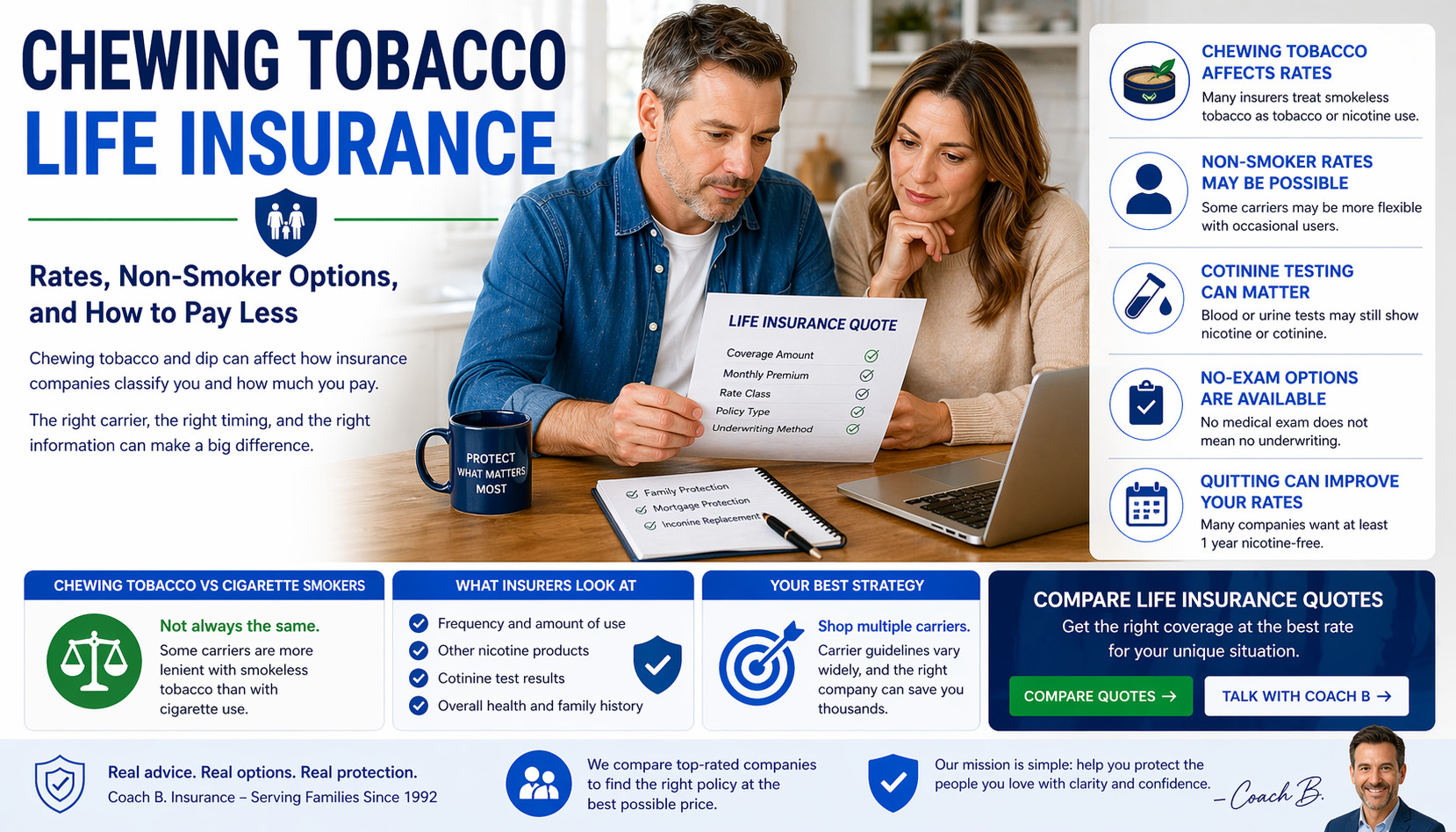
- Yes, most chewing tobacco users can still qualify for life insurance.
- Many insurers treat chewing tobacco as tobacco or nicotine use, even if you do not smoke cigarettes.
- Some carriers may be more flexible with occasional smokeless tobacco users.
- Blood or urine testing can still matter because nicotine or cotinine may show up.
- The best result usually comes from shopping the right carrier, not assuming all companies treat dip the same way.

Scott Benton (a.k.a. Coach B.)
Author: Scott Benton, Licensed Life Insurance Agent
Experience: Serving families since 1992
Disclosure: Coach B. Insurance may be compensated if you purchase through our agency. Recommendations are based on underwriting fit, clarity, and usefulness — not pressure.
Editorial note: This page is the chewing-tobacco spoke inside the broader smoker cluster. It is not about all nicotine use. It is specifically about dip, chew, and smokeless-tobacco underwriting.
Why Chewing Tobacco Affects Life Insurance Rates
Insurance companies do not separate people into smoker and non-smoker based only on everyday language. They underwrite based on risk, and nicotine use is one of the clearest examples.
Nicotine still matters
Chewing tobacco may be smokeless, but it still usually falls into a broader tobacco or nicotine bucket.
Rates often rise
Many carriers charge more when a chewing tobacco user is placed in a tobacco class.
Carrier rules vary
Some companies are stricter, while others may be more forgiving with smokeless tobacco than with cigarette use.
Health still matters too
Age, blood pressure, cholesterol, family history, and the rest of your health profile still affect the final rate.
Can Tobacco Chewers Get Non-Smoker Rates?
Sometimes, yes
This is the question behind a lot of searches, and sometimes the answer is yes. A few carriers may treat smokeless tobacco users more favorably than cigarette smokers, especially when use is occasional and the rest of the file is strong.
But do not assume it
Many insurers will still place chewing tobacco users into a tobacco class. That is why one quote is never enough for this niche.
Use frequency
Daily use usually gets looked at differently than occasional use.
Other nicotine products
If you also smoke, vape, or use nicotine pouches, flexibility usually drops fast.
Cotinine results
Exam findings can reinforce how the carrier classifies you.
Overall health class
A strong file gives you the best shot at more favorable treatment where available.
Chewing Tobacco vs Cigarette Smoker Rates
| Situation | What Often Happens | Best Move |
|---|---|---|
| Daily chewing tobacco use | Often tobacco-rate treatment | Shop multiple carriers before applying |
| Occasional smokeless tobacco use | May still get tobacco rates, but some carriers can be more flexible | Use carrier-specific quote comparison |
| Chewing tobacco plus cigarettes or vaping | Usually stricter treatment | Expect smoker-style pricing more often |
| Former chewing tobacco user | May improve after a nicotine-free period | Match the application date to the best reclassification window |
The key takeaway is not that chewing tobacco is always treated like cigarettes. It is that carrier differences matter more here than many shoppers realize.
Does Chewing Tobacco Show Up on a Life Insurance Exam?
It can, and often does
Fully underwritten life insurance commonly includes blood and urine testing, and nicotine or cotinine can matter even for smokeless tobacco users.
Do not treat “smokeless” like “invisible”
One of the biggest mistakes is assuming that because there is no smoke, underwriting will not see it.
Be honest on the application
Trying to hide tobacco use can create bigger problems than the rate itself.
No-exam is not a loophole
No-exam policies may still ask about nicotine use and still use outside data sources.
Exam vs no-exam should be compared
If your goal is the lowest premium, compare both paths instead of assuming the faster route is cheaper.
What If You Want No-Exam Life Insurance?
Good for speed
No-exam coverage can make sense if fast approval matters most.
Not always best for price
Traditional underwriting may still produce the better class in some chewing-tobacco cases.
Still underwritten
No-exam means no paramed exam, not no review of nicotine use or background data.
Life Insurance After Quitting Chewing Tobacco
Timing matters
Quitting is great, but the underwriting benefit usually depends on how long you have actually been nicotine-free.
A year is a common starting point
Some carriers may start reconsidering better treatment after about 12 months, while stricter carriers may want longer.
| Quit Timeline | What It Often Means |
|---|---|
| Recently quit | Often still too soon for the best non-tobacco outcome |
| Around 12 months nicotine-free | Some carriers may start reconsidering better rate treatment |
| 1 to 3 years nicotine-free | More carriers may open up, depending on the full health file and product |
How Coach B Would Shop This
Step 1: define the actual use pattern
Daily, occasional, former user, or mixed nicotine use all get looked at differently.
Step 2: separate dip from the rest of the file
Then I would look at the rest of your health profile so chewing tobacco is not the only thing guiding the strategy.
Step 3: match the case to the right carrier
That is where the money usually is on this topic — choosing the company most likely to treat smokeless tobacco fairly.
The Bottom Line
Chewing tobacco does not usually block you from getting life insurance. But it does make underwriting strategy matter a lot more.
The best outcome usually comes from understanding whether you are likely to be treated as tobacco, whether non-smoker treatment is even realistic, and which carrier is most competitive for your exact use pattern.
Helpful Related Pages
Life Insurance for Smokers
Best next page if you want the broader nicotine and tobacco umbrella page.
See Smoker Underwriting →Life Insurance Classifications
Best next page if you want to understand how rate classes change what you pay.
See Life Insurance Classifications →No Medical Exam Life Insurance
Best next page if speed matters and you want to compare no-exam options for nicotine users.
Explore No-Exam Options →Instant Issue Life Insurance
Best next page if speed matters more than perfect pricing.
See Instant Issue Options →Frequently Asked Questions
Can you get life insurance if you chew tobacco?
Yes. Most chewing tobacco users can still qualify for term life, whole life, and even some no-exam coverage.
Will chewing tobacco make me a smoker for life insurance?
Often yes, but not always. Some carriers may be more flexible with occasional smokeless tobacco users than with cigarette smokers.
Does chewing tobacco show up on a life insurance exam?
It can. Blood and urine testing may still surface nicotine or cotinine.
Can I get non-smoker rates if I use dip?
Sometimes, depending on the carrier, your use pattern, your overall health, and whether other nicotine products are involved.
How long after quitting chewing tobacco can rates improve?
Some carriers may start reconsidering better treatment after about a year nicotine-free, while stricter carriers may want longer.


