
How Much Burial Insurance Do I Need? $10,000 vs $15,000 vs $20,000 vs $25,000
The right burial insurance amount depends on what you actually want the policy to do. Some families only want help with funeral costs. Others want room for burial expenses, medical bills, small debts, and a little breathing room after a loss.
That is why this page matters. Most people do not really need a long explanation of what burial insurance is. They need help answering one practical question: how much burial insurance is enough for my situation without paying for more coverage than I need?
This guide helps you compare the most common burial insurance amounts — $10,000, $15,000, $20,000, and $25,000 — so you can choose the amount that best fits your funeral costs, debts, family needs, and budget.
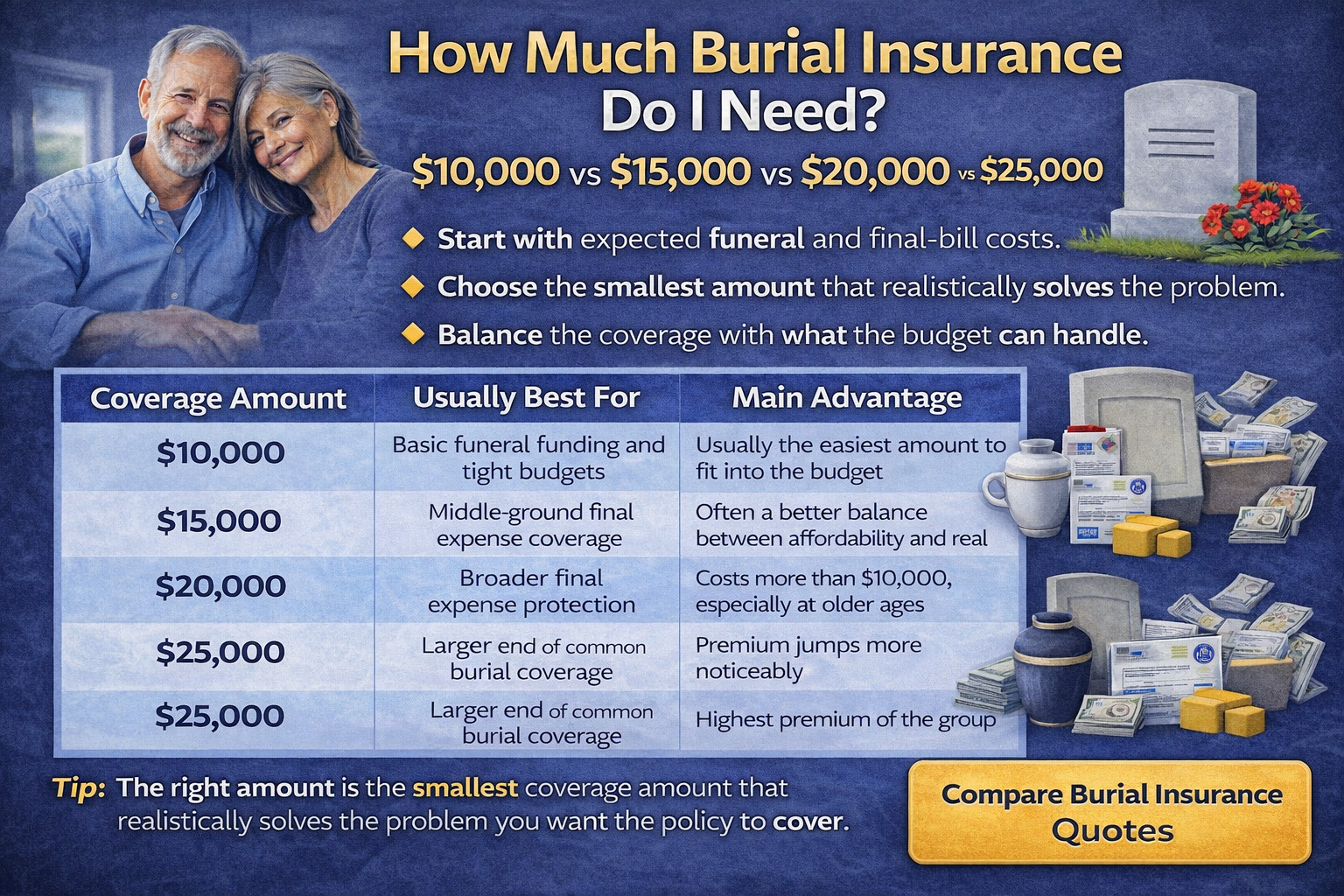
- $10,000 is often a basic starting point for simple funeral funding.
- $15,000 is often a stronger middle-ground amount for funeral costs plus a few final bills.
- $20,000 is often a fuller final expense amount for families wanting more breathing room.
- $25,000 is usually the larger end of common burial coverage and can help with funeral costs plus debts or extra family needs.
- The right amount is the smallest coverage amount that realistically solves the problem you want the policy to cover.

Scott Benton (a.k.a. Coach B.)
Author: Scott Benton, Licensed Life Insurance Agent
Experience: Serving families since 1992
Disclosure: Coach B. Insurance may be compensated if you purchase through our agency. Recommendations are based on product fit, underwriting, clarity, and usefulness — not pressure.
Editorial note: The biggest mistake people make with burial insurance is not always buying too little. It is buying an amount without first deciding what the policy needs to cover and how much monthly premium they can comfortably keep in place.
What Burial Insurance Is Usually Meant to Cover
Burial insurance is usually meant to help families handle expenses that show up quickly after a death. For some people that means only the funeral. For others it also means cemetery costs, cremation expenses, medical bills, or smaller debts.
Funeral home costs
This is usually the first reason people buy burial insurance.
Burial or cremation expenses
Burial, cremation, memorial, and cemetery costs can add up quickly.
Final medical bills
Some families want the policy to absorb leftover medical or household bills too.
Extra breathing room
A slightly larger policy can give loved ones more flexibility during a difficult time.
How to Estimate How Much Burial Insurance You Need
Start with the main cost categories
- funeral or memorial service
- burial or cremation
- cemetery or urn costs
- small debt or medical balances
- extra cash cushion for the family
Then subtract what is already covered
- existing savings set aside for funeral costs
- prepaid funeral or cemetery arrangements
- other small policies already in force
- family resources you know will be available
A simple way to think about it:
Estimated funeral and final costs – existing savings or prepaid arrangements = burial insurance amount to price out first.
$10,000 vs $15,000 vs $20,000 vs $25,000 Burial Insurance
These are the most practical common amount choices for burial-focused final expense coverage. The right fit depends on how much of the final expense problem you want the policy to solve.
| Coverage Amount | Usually Best For | Main Advantage | Main Tradeoff |
|---|---|---|---|
| $10,000 | Basic funeral funding and tight budgets | Usually the easiest amount to fit into the budget | May leave the family short on total final expenses |
| $15,000 | Middle-ground final expense coverage | Often a better balance between affordability and real-world funeral support | Costs more than $10,000, especially at older ages |
| $20,000 | Broader final expense protection | Can cover funeral costs and leave room for extra bills | Premium jumps more noticeably |
| $25,000 | Larger end of common burial coverage | Often handles funeral costs plus debts or added family support | Highest premium of the group |
Which Burial Insurance Amount Usually Fits Best?
$10,000
Usually best when the goal is simple funeral funding and affordability matters most.
$15,000
Usually best when you want more than the minimum but still need a middle-ground premium.
$20,000
Usually best when the family wants broader final expense protection and some extra room.
$25,000
Usually best when you want the larger end of common burial coverage and can handle the higher premium.
When You May Need Less Burial Insurance
You already have savings
If you already have money set aside for funeral costs, you may only need a smaller burial policy to close the gap.
You have prepaid arrangements
Prepaid funeral or cemetery arrangements can reduce how much coverage you need to buy now.
The goal is only simple funeral funding
If the policy is only meant to cover a basic service, a smaller amount may be the smarter fit.
When You May Need More Burial Insurance
There will likely be extra bills
If the family may face medical bills, debts, or household expenses, a larger amount may be more realistic.
Funeral costs in your area are higher
If you expect above-average burial or service costs, the smallest amount may not be enough.
You want more breathing room for family
Some buyers intentionally choose a larger amount so loved ones have flexibility after death.
How Coach B Would Choose the Right Burial Insurance Amount
Step 1: define the job
Is the policy only for funeral costs, or do you also want it to help with bills and family support?
Step 2: choose the smallest amount that solves the problem
The goal is not automatically buying the biggest amount. The goal is buying enough without overspending.
Step 3: check the premium honestly
A larger policy only helps if the monthly premium is still comfortable enough to keep in force.
The Bottom Line
The right burial insurance amount is the smallest amount that realistically covers the funeral, burial, and final expense problem you want the policy to solve.
For some families that is $10,000. For others it is $15,000, $20,000, or $25,000. The smartest move is not chasing the lowest premium or the biggest benefit. It is matching the coverage amount to the real job and your real budget.
Helpful Related Pages
$10,000 Burial Insurance Cost by Age
Best next page if you want to see how the smallest common burial amount prices out by age.
See $10,000 Rates →$15,000 Burial Insurance Cost by Age
Best next page if you want a middle-ground burial amount with more room than $10,000.
See $15,000 Rates →$20,000 Burial Insurance Cost by Age
Best next page if you want broader final expense support and more breathing room.
See $20,000 Rates →$25,000 Burial Insurance Cost by Age
Best next page if you want the larger end of common burial insurance amounts.
See $25,000 Rates →Final Expense Insurance Rates by Age
Best next page if you want the broader age-based pricing guide across multiple coverage amounts.
See Broad Rate Guide →Cheap Burial Insurance
Best next page if keeping monthly premium lower is still your top concern.
See Low-Cost Options →Burial Insurance With No Waiting Period
Best next page if speed of coverage matters as much as coverage amount.
See No-Waiting-Period Options →Final Expense Insurance for Seniors
Best next page if you want the broader senior buying guide beyond just amount selection.
Open the Senior Guide →Frequently Asked Questions
How much burial insurance do I need?
You usually need enough to cover the funeral, burial or cremation costs, and any final bills you want the policy to help absorb, minus any savings or prepaid arrangements already in place.
Is $10,000 enough for burial insurance?
Sometimes yes. It can work for basic funeral funding, but some families will want more room for burial costs, debt, or medical bills.
Is $15,000 or $20,000 a better amount than $10,000?
For many families, yes. Those amounts often create more realistic breathing room for total final expenses, though the right fit depends on the budget and what the policy needs to cover.
Can burial insurance also help with debts or medical bills?
Yes. Many people use burial insurance for more than funeral costs alone, especially if they choose a larger amount like $15,000, $20,000, or $25,000.
What is the biggest mistake when choosing a burial insurance amount?
The biggest mistake is choosing an amount only because the premium looks cheaper without checking whether that amount actually solves the funeral and final expense problem you want the policy to cover.


