
Term Life Insurance Advantages and Disadvantages: Pros, Cons, and Best Fit
Term life insurance is popular because it gives many families the most coverage for the lowest cost. But low cost is not the same thing as perfect fit.
That is why this page matters. Most people are not asking whether term life is “good” or “bad.” They are trying to understand what it does really well, where it comes up short, and whether those tradeoffs match their actual situation.
The real question is not just what the advantages and disadvantages of term life insurance are. The real question is whether the strengths of term line up with your needs better than the tradeoffs bother you.
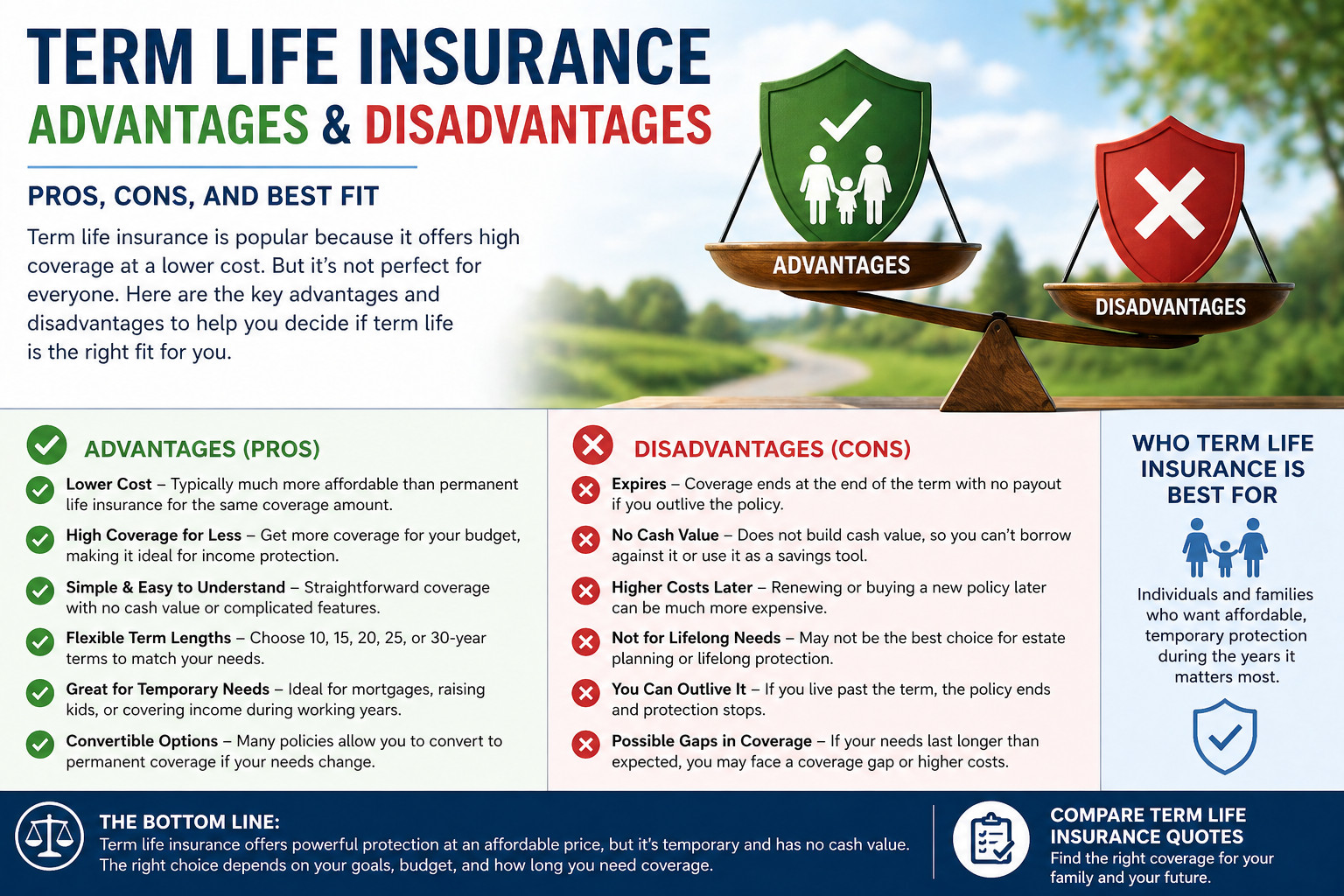
- The biggest advantages are affordability, simplicity, and strong temporary protection.
- The biggest disadvantages are expiration, no cash value, and higher costs later if you still need coverage.
- Term life usually fits best when the need is temporary and clearly defined.
- Permanent coverage may fit better when the need is lifelong.
- The right choice depends less on ideology and more on what job the policy needs to do.

Scott Benton (a.k.a. Coach B.)
Author: Scott Benton, Licensed Life Insurance Agent
Experience: Serving families since 1992
Disclosure: Coach B. Insurance may be compensated if you purchase through our agency. Recommendations are based on fit, clarity, and usefulness — not pressure.
Editorial note: This page is the balanced term-life pros-and-cons page. It is meant to stay separate from the downside-only page and the term-vs-whole comparison page.
What Term Life Insurance Is in Plain English
Term life insurance gives you coverage for a set number of years, usually 10, 20, or 30. If you die during that term, your beneficiaries receive the death benefit. If you outlive the term, the policy ends.
Temporary coverage
Term is built to cover a specific financial season, not necessarily your whole life.
Fixed time window
The policy usually lasts for a defined term like 10, 20, or 30 years.
Death-benefit focused
The policy’s main job is protection, not building value inside the contract.
Usually the lowest-cost option
For many buyers, term gives the biggest death benefit for the lowest starting premium.
The Main Advantages of Term Life Insurance
1. Lower cost upfront
Term life is usually much more affordable than permanent life insurance for the same death benefit, which makes larger coverage amounts possible for many families.
2. Strong income-replacement tool
Term works well when the goal is protecting kids, a spouse, a mortgage, or working-year income.
3. Simpler to understand
Term life is usually easier to explain because it does not ask buyers to sort through cash-value features, policy loans, or accumulation strategy.
4. Flexible term lengths
A buyer can often match the term to the actual need window, whether that is a mortgage, kids-at-home years, or income replacement.
5. High coverage is often realistic
Because term is usually cheaper, buyers can often afford more meaningful protection amounts than they could with permanent coverage.
6. It can be a clean bridge strategy
Some buyers use term to solve today’s protection problem while leaving room to revisit permanent planning later if needed.
The Main Disadvantages of Term Life Insurance
1. Coverage ends
The biggest downside is built into the product. Term life eventually expires, so the protection is not designed to last forever.
2. No cash value
Standard term life does not build internal cash value, which means no borrowing feature and no savings component inside the policy.
3. Renewal later can get expensive
If you still need coverage when the term ends, the next step is often much more expensive because you are older and may have changed health.
4. It may not solve lifelong needs
If your goal is final expenses, legacy planning, or permanent family protection, term may only be a partial answer.
5. You can outlive it
That is emotionally frustrating for some buyers because the policy may do exactly what it was designed to do and still feel like “nothing was paid back.”
6. It can be easy to underbuy the future
Some people choose term because it is cheap without fully thinking through whether they may still need protection later in life.
Term Life Pros and Cons at a Glance
| Question | Term Life Strength | Term Life Tradeoff |
|---|---|---|
| Cost | Usually much lower at the start | May cost more later if you still need coverage |
| Coverage size | Large death benefit is often affordable | Protection is temporary |
| Simplicity | Easy to understand and compare | No cash value or policy-access feature |
| Fit | Excellent for temporary needs | Weaker fit for lifelong needs |
| Flexibility later | Some policies offer conversion options | Not every buyer uses that option in time |
When the Advantages Usually Outweigh the Disadvantages
You have a temporary need
This is often the clearest sign term is a strong fit.
Budget matters a lot
Term’s affordability is one of its biggest advantages.
You need meaningful coverage now
Term often lets buyers protect more at a lower cost.
You prefer simplicity
A straightforward policy is often easier to keep and understand.
When the Disadvantages Matter More
You want lifelong coverage
Expiration becomes a much bigger issue when the need is permanent.
You want cash value
Term does not offer that kind of policy structure.
You may need coverage later no matter what
The risk of higher future cost matters more in this case.
You want permanent planning certainty
Whole life or another permanent design may fit better.
Term Life vs Whole Life: Why the Pros and Cons Matter
Why term wins for many families
Term often wins when the main goal is affordable protection during the highest-risk years, especially when budget and coverage size matter most.
Why permanent coverage still matters
Permanent policies solve a different job. They may fit better when the need is not temporary and the buyer values lifelong structure more than low initial cost.
How Coach B Would Think About It
Step 1: define the real job
Is this about temporary income protection, a mortgage, or something permanent?
Step 2: stress-test the downside
I would ask what happens if the need lasts longer than expected or health changes later.
Step 3: choose the cleanest fit
The best policy is not the one with zero tradeoffs. It is the one whose tradeoffs still fit your life best.
The Bottom Line
The main advantages of term life insurance are affordability, simplicity, and strong temporary protection. The main disadvantages are expiration, no cash value, and the possibility of much higher costs later if you still need coverage.
For many families, the pros outweigh the cons because the job is temporary and the budget matters. But if the need is lifelong, the disadvantages matter much more, and a permanent policy may fit better.
Helpful Related Pages
Term Life Insurance Disadvantages
Best next page if you want the downside case only without the balancing advantages.
See Term Downsides →What Happens If You Outlive Your Term Life Insurance?
Best next page if your main concern is what happens when the term ends and what to do next.
See What Happens at Expiration →Term vs Whole Life Insurance
Best next page if the real decision is whether temporary or permanent coverage fits better.
Compare Term vs Whole Life →Term Life Insurance Hub
Best next page if you want the broader term-life guide and quote-shopping page.
Explore Term Life →Frequently Asked Questions
What are the main advantages of term life insurance?
The main advantages are lower cost, simplicity, strong temporary protection, and the ability to buy meaningful coverage for a relatively affordable premium.
What are the main disadvantages of term life insurance?
The main disadvantages are that it expires, builds no cash value, and can become much more expensive later if you still need coverage.
Is term life insurance worth it?
It often is when the coverage need is temporary and the main goal is affordable family protection during the highest-risk years.
Does term life insurance have cash value?
Standard term life insurance usually does not build cash value.
When does permanent life insurance fit better than term?
Permanent life insurance usually fits better when the need is lifelong, the buyer wants lasting coverage, or cash-value structure matters.


