
Captive vs Independent Insurance Agents: Pros, Cons, and Which Is Better for Life Insurance?
The cleanest difference is simple: a captive agent usually sells for one company, while an independent agent can usually compare multiple companies they are appointed with.
That is why this page matters. Most people are not just asking for definitions. They are asking whether one model gets them better pricing, better underwriting flexibility, better service, or a better chance of finding the right life insurance fit.
The real question is not just captive vs independent insurance agents. The real question is which model gives you the best chance of finding the right coverage for your situation without getting boxed into the wrong carrier too early.
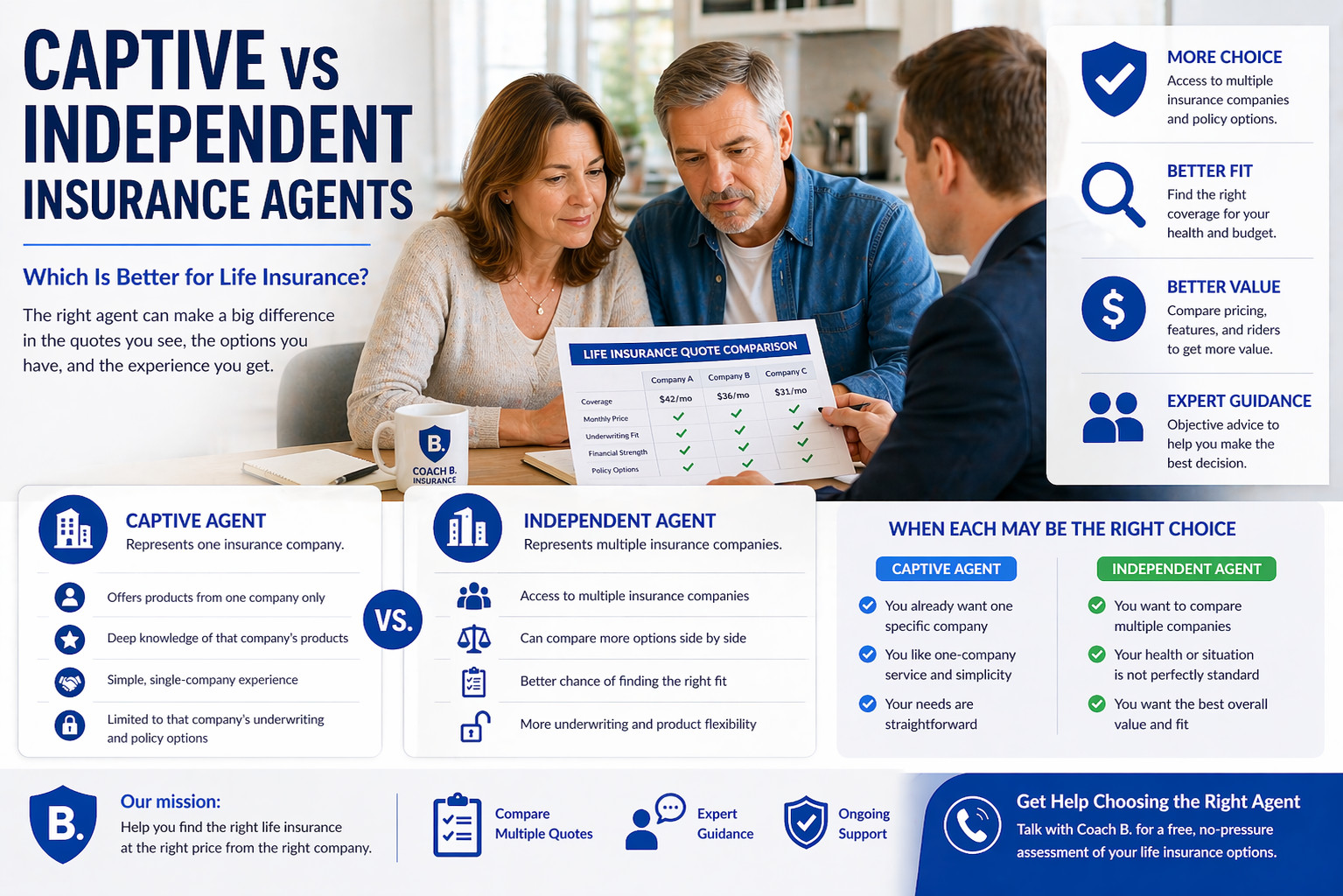
- A captive agent usually sells for one insurance company.
- An independent agent usually compares multiple companies they are appointed with.
- Captive can be a good fit for brand loyalty and simplicity.
- Independent is often stronger when you want rate-shopping or better underwriting fit.
- For life insurance specifically, independent often matters more when health, age, or policy design are not straightforward.

Scott Benton (a.k.a. Coach B.)
Author: Scott Benton, Licensed Life Insurance Agent
Experience: Serving families since 1992
Disclosure: Coach B. Insurance may be compensated if you purchase through our agency. Recommendations are based on fit, underwriting clarity, and usefulness — not pressure.
Editorial note: This page is about how to shop smarter, not just who sounds better in a headline. The right answer usually depends on whether you need one brand’s system or a real market comparison.
What Captive and Independent Actually Mean
Captive and independent both describe how an agent is connected to insurance companies, not whether the person is licensed or legitimate. Both can be real professionals. The difference is mostly about how many carriers they can bring to the table.
Captive agent
Usually represents one insurance company and sells that company’s policies.
Independent agent
Usually represents multiple insurance companies and can compare appointed carriers.
Both represent insurers
Both models are still working within insurance-company relationships, just with different levels of carrier choice.
Not every independent can shop all carriers
Independent does not mean every company in America. It usually means multiple carriers within that agent’s appointments.
Captive vs Independent Insurance Agents: Side-by-Side
| Category | Captive Agent | Independent Agent |
|---|---|---|
| Carrier access | Usually one company | Usually multiple appointed companies |
| Best fit | Brand loyalty, simplicity, one-company ecosystem | Comparison shopping, flexibility, trickier cases |
| Life-insurance shopping style | One carrier’s best option | Multiple carriers compared side by side |
| Underwriting flexibility | Limited to one company’s appetite | More chances to match the case to the right carrier |
| Main tradeoff | Less market comparison | Not every carrier is available through one independent agent |
Why Independent Often Matters More in Life Insurance
Underwriting is not uniform
One carrier may love your case. Another may rate it up. Another may decline it. That matters more in life insurance than many buyers realize.
Policy design can vary
Term, no-exam, universal life, final expense, and guaranteed issue all behave differently across carriers.
Price is not the only variable
The cheapest quote is not always the best quote if the underwriting fit or rider structure is weak.
When a Captive Agent Can Be the Better Move
You already know the brand you want
If you are committed to one company already, captive can make the process feel simpler.
You value one-company service
Some buyers like staying inside one company’s service model, claims system, and support culture.
Your needs are simple
Straightforward shoppers with standard needs may not need a big market search.
You want fewer moving parts
Some people simply prefer a tighter one-company process over broader comparison.
When an Independent Agent Is Usually the Better Move
You want multiple quotes
Independent is usually the cleaner fit when your goal is true comparison instead of one-company presentation.
Your case is not perfectly standard
Health history, age, tobacco use, hobbies, and medications can make carrier fit much more important.
You care about underwriting fit
The right independent agent can often tell which carrier is more likely to look at your case favorably.
You want market flexibility
Independent can be the better fit when you want options instead of one company’s built-in answer.
The Most Common Misunderstandings
What people get wrong about independent agents
- independent does not mean every insurer in the market
- independent does not automatically mean cheaper every time
- independent still requires transparency and good explanation
What people get wrong about captive agents
- captive does not mean bad or unhelpful
- captive can still be a strong fit for certain buyers
- service quality usually depends on the actual agent, not just the label
How Coach B Would Help You Decide
Step 1: decide if you need comparison
If you are clearly shopping multiple possibilities, independent usually makes more sense.
Step 2: look at how standard your case is
The less standard the case, the more valuable carrier flexibility usually becomes.
Step 3: match the model to the goal
If your goal is brand simplicity, captive can fit. If your goal is best-fit shopping, independent usually wins.
The Bottom Line
Captive and independent agents are both real insurance models. The difference is not professionalism. The difference is how much carrier choice you want sitting in front of you.
For life insurance, independent is often the stronger path when you want better comparison, more underwriting flexibility, or a smarter quote-shopping process. Captive can still be the better move when you want one-brand simplicity and already know where you want to land.
Helpful Related Pages
Life Insurance Classifications
Best next page if you want to understand why carrier choice can matter so much in underwriting.
See Life Insurance Classifications →Life Insurance Buyer’s Guide
Best next page if you want the broader buying framework before picking an agent model.
Open Buyer’s Guide →Life Insurance Online
Best next page if you want to compare online shopping versus agent-guided buying.
See Online Buying Options →No Medical Exam Life Insurance
Best next page if your goal is speed and convenience, not just agent-type comparison.
Explore No-Exam Coverage →Frequently Asked Questions
What is a captive insurance agent?
A captive insurance agent usually sells insurance for one company and works within that company’s product lineup.
What is an independent insurance agent?
An independent insurance agent usually represents multiple insurance companies and can compare policies from appointed carriers.
Is an independent agent always better for life insurance?
Not always, but independent is often stronger when you want multi-carrier comparison, tougher-case underwriting flexibility, or broader quote-shopping.
Can an independent agent shop every company?
Usually no. Independent agents can normally shop the companies they are appointed with, not every carrier in the market.
When is a captive agent the better fit?
A captive agent can be a good fit when you want one-brand simplicity, already know the carrier you want, or do not need broad comparison.


