
Final Expense vs Term Life Insurance: Which Fits You Best?
Final expense and term life insurance solve two very different problems. One is usually built for smaller permanent burial and final-bill needs. The other is usually built for larger temporary protection like income replacement, mortgage payoff, and family coverage.
That is why this page matters. A lot of shoppers are not really asking which policy is “better.” They are trying to figure out whether they need a smaller permanent burial-style policy or a bigger temporary policy that protects the people depending on them.
The right answer depends on the job the death benefit needs to do. If the goal is funeral costs and final bills, final expense usually makes more sense. If the goal is larger family protection for a set number of years, term life usually makes more sense.
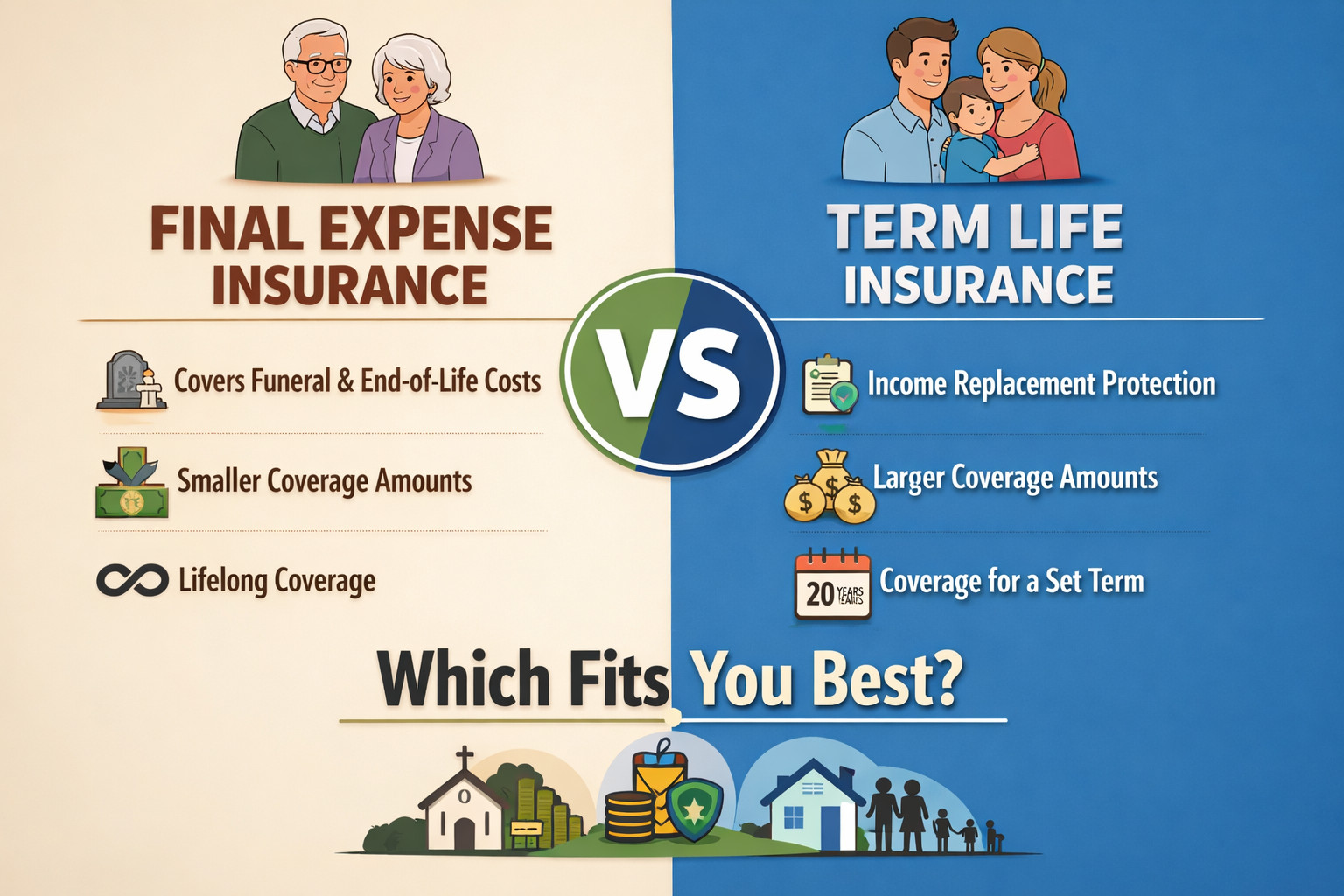
Final expense is usually a smaller permanent whole-life-style policy for burial costs and final bills. Term life is usually a larger temporary policy for income replacement, mortgage protection, and family coverage.
- Final expense usually lasts for life
- Term life usually lasts 10, 20, or 30 years
- Final expense is usually easier to qualify for
- Term life usually gives more coverage for the money

Scott Benton (a.k.a. Coach B.)
Author: Scott Benton, Licensed Life Insurance Agent
Experience: Serving families since 1992
Disclosure: Coach B. Insurance may be compensated if you purchase through our agency. Recommendations are based on product fit, underwriting, clarity, and usefulness — not pressure.
Editorial note: This comparison is not really about which policy is better in the abstract. It is about choosing the type of policy that fits the real financial problem you are trying to solve.
The Fastest Way to Understand the Difference
Final expense and term life are built for different jobs.
Final expense is usually for:
- funeral costs
- burial and cremation expenses
- small medical bills
- small debts or end-of-life household expenses
Term life is usually for:
- income replacement
- mortgage payoff
- larger family protection
- covering financial risk during working years
Final Expense vs Term Life Insurance: Side-by-Side
What Final Expense Usually Does Better
Permanent coverage
Final expense is usually built as a permanent whole life style policy rather than something that ends after a fixed term.
Burial and funeral fit
This is the cleaner tool when the goal is covering funeral costs, cremation, or other final expenses.
Easier approval
Final expense is often easier to qualify for than larger traditional policies, especially for older buyers.
Better senior fit
For many seniors who only want a smaller permanent policy, final expense is often the more natural fit than term.
What Term Life Usually Does Better
More coverage for the money
Term life usually gives much larger death benefit amounts at a lower monthly cost than permanent burial-style coverage.
Income replacement
This is usually the stronger fit when the goal is replacing years of lost household income.
Mortgage protection
Term life is usually stronger when you want to protect the years your family still has a mortgage balance.
Younger family fit
For parents and working households, term life is often the more practical first policy to consider.
The Waiting Period Difference Matters
Final expense may include waiting periods
If the buyer ends up in graded benefit or guaranteed issue final expense, full natural-death benefits may not begin immediately. That is why plan type matters so much in burial coverage shopping.
Term life is usually not bought for this issue
Term life is usually not compared through the same burial waiting-period lens. The bigger issue with term is usually whether the policy length and death benefit fit the family’s timeline and needs.
Who Fits Which One?
Age 35 with kids and a mortgage
Usually term life. The need is larger and temporary, not just final expense planning.
Age 72 wanting burial coverage only
Usually final expense. The goal is smaller permanent burial-focused protection.
Age 68 wanting easier approval and a smaller permanent policy
Usually final expense. Simpler approval and lifelong smaller coverage usually point that direction.
Age 45 wanting $500,000 of protection
Usually term life. The need is bigger and family-focused, not just burial coverage.
The Simplest Decision Rule
Choose final expense when:
- the goal is funeral or burial funding
- you want smaller permanent coverage
- easier approval matters more than a large death benefit
- you are shopping later in life
Choose term life when:
- the goal is family income protection
- you need more death benefit
- you want to cover a mortgage or temporary financial risk
- budget efficiency matters heavily
The core question
Ask what the money needs to do. If it is mainly for final bills, final expense usually fits better. If it is mainly for income replacement or family protection, term life usually fits better.
The Bottom Line
Final expense is usually for final bills. Term life is usually for bigger temporary protection. The right policy depends on the job the money needs to do.
If your main goal is funeral and burial costs, final expense usually fits better. If your main goal is mortgage protection, income replacement, or family security during working years, term life usually fits better.
Helpful Related Pages
Final Expense Insurance
Best next page if final bills and burial planning are probably your real goal.
Explore Final Expense →Final Expense Life Insurance Plan
Best next page if you are leaning final expense and need to compare level, graded, and guaranteed issue.
Compare Final Expense Plans →Term Life Insurance
Best next page if larger temporary protection may actually be the better fit.
Explore Term Life →Term Life Insurance for Mortgage Payoff
Best next page if protecting the home is the main reason you are considering life insurance.
See Mortgage Fit →Burial Insurance With No Waiting Period
Best next page if your real concern is immediate burial coverage.
See No-Waiting-Period Options →Term vs Whole Life Insurance
Best next page if you are still deciding between temporary and permanent coverage more broadly.
Compare Term vs Whole →Frequently Asked Questions
Is final expense insurance cheaper than term life insurance?
Not usually on a per-dollar-of-coverage basis. Final expense is often smaller and easier to qualify for, but term life usually gives more death benefit for the money.
Is final expense insurance permanent?
Usually yes. Final expense is commonly built as a smaller permanent whole life style policy.
Who should usually buy term life instead of final expense?
People who need larger temporary protection for a mortgage, spouse, children, or income replacement usually should look at term life first.
Who should usually buy final expense instead of term life?
Buyers who mainly want burial, funeral, and final-bill coverage — especially older seniors wanting smaller permanent protection — usually should look at final expense first.
Can final expense insurance have a waiting period?
Yes. Depending on the plan type, final expense may involve graded or guaranteed issue structures with delayed full natural-death benefits.


