
Guaranteed Issue vs Final Expense Life Insurance: What’s the Difference in 2026?
This is one of the most confusing topics in senior life insurance because people often treat guaranteed issue and final expense like they are the same thing.
They are related, but they are not identical. In plain English, final expense usually describes the kind of small permanent policy people buy for funeral costs and end-of-life bills, while guaranteed issue usually describes the easiest approval path inside that world.
The real question is not just “guaranteed issue vs final expense.” The real question is whether you need a fallback approval lane or whether you may still qualify for a stronger-value final expense policy.
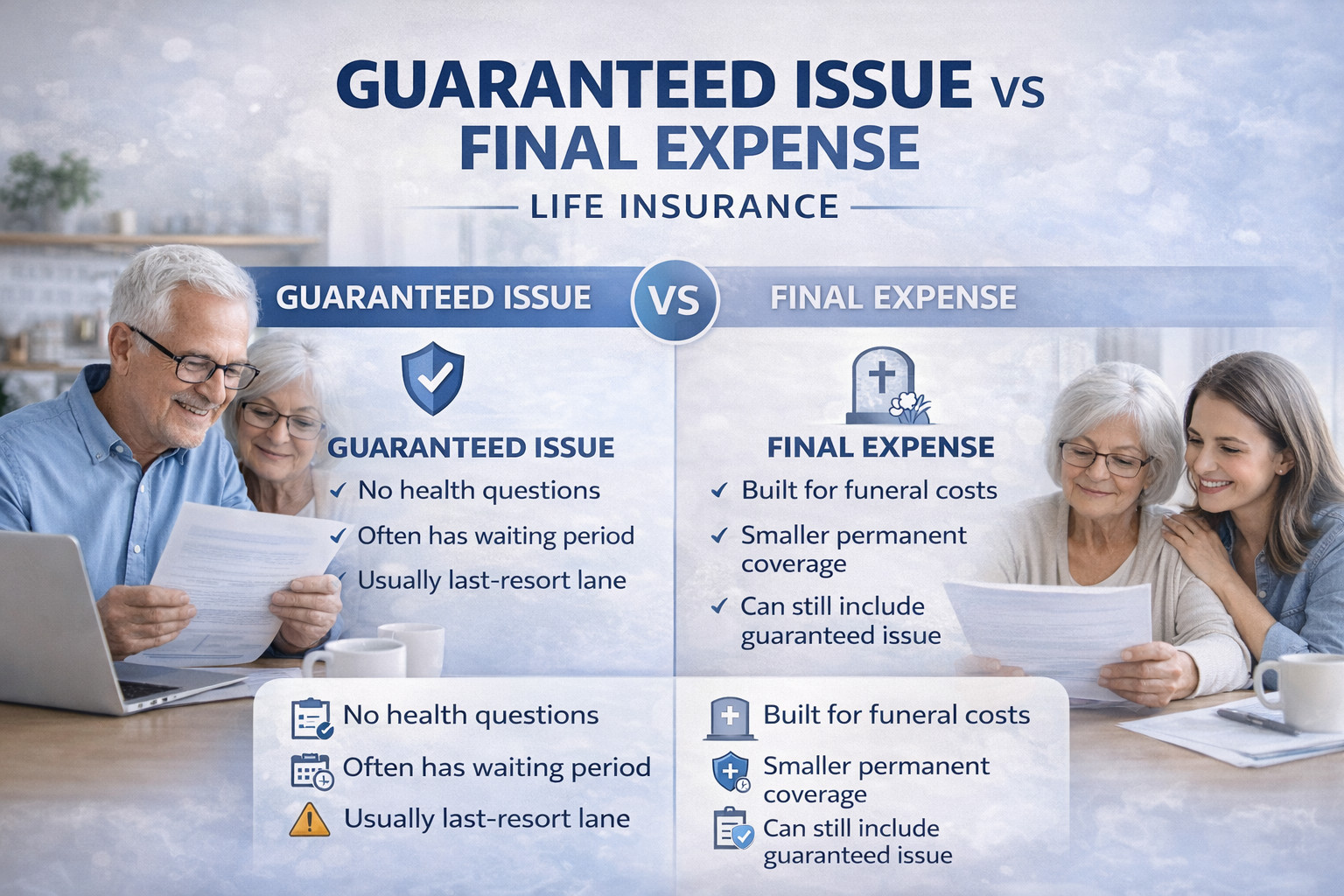
- Final expense is usually the broader category or goal.
- Guaranteed issue is usually one approval path inside final expense.
- If you can qualify for simplified or stronger final expense underwriting, it is often better value.
- Guaranteed issue is usually the fallback for serious health concerns, prior declines, or no-health-question needs.
- Waiting-period language matters a lot more with guaranteed issue.

Scott Benton (a.k.a. Coach B.)
Author: Scott Benton, Licensed Life Insurance Agent
Experience: Serving families since 1992
Disclosure: Coach B. Insurance may be compensated if you purchase through our agency. Recommendations are based on product fit, underwriting, clarity, and usefulness — not pressure.
Editorial note: The biggest mistake on pages like this is acting like guaranteed issue and final expense are competing products. They overlap. The real job is figuring out which underwriting lane gives you the best value for your health and your goal.
What Each One Really Means
Before you compare them, it helps to use the terms the right way. That alone clears up most of the confusion.
Guaranteed issue
Usually means very easy approval, often with no health questions or medical exam, but with higher cost and more benefit tradeoffs.
Final expense
Usually means a smaller permanent policy meant to help cover funeral costs, burial costs, and other end-of-life bills.
Simplified issue final expense
Usually means no medical exam, but some health questions. If approved, it is often a better value than guaranteed issue.
Why people mix them up
Because guaranteed issue is often sold for final-expense needs, people treat them like synonyms when they are really overlapping ideas.
Guaranteed Issue vs Final Expense: Side-by-Side
| Comparison Point | Guaranteed Issue | Final Expense |
|---|---|---|
| What it usually means | An underwriting path with easier approval | A smaller permanent policy built for funeral and end-of-life costs |
| Health questions | Usually none | Can be simplified issue, graded, level, or guaranteed issue depending on carrier |
| Medical exam | Usually no | Usually no |
| Pricing value | Usually weaker value per premium dollar | Often better value if you qualify for stronger underwriting |
| Waiting period risk | Often more likely to matter | Depends on whether the policy is level, graded, modified, or guaranteed issue |
| Best fit | Serious health concerns, prior declines, or no-health-question need | Buyers wanting smaller lifelong coverage for final expenses |
The key idea is that final expense is often the bigger bucket, while guaranteed issue is one lane inside it.
Choose Final Expense First If…
You may still qualify for better underwriting
If you can answer health questions honestly and still fit simplified or stronger final expense underwriting, you will usually get more value than guaranteed issue.
- more coverage for the same premium in many cases
- cleaner value if health is not severely impaired
- more room to compare level vs graded vs modified options
- better place to start for many seniors
Your goal is simple end-of-life coverage
If your real goal is funeral costs, burial costs, cremation costs, small medical bills, or leaving a modest benefit behind, final expense is usually the right category to start in.
- designed around smaller permanent face amounts
- commonly used by seniors
- can still include guaranteed issue if needed later
- lets you shop the full final-expense lane first
Choose Guaranteed Issue If…
Health is the main obstacle
Guaranteed issue is usually the fallback when health concerns, assisted living, terminal illness, or prior declines make other options less realistic.
- serious medical history
- declined elsewhere
- need a no-health-question path
- main goal is preserving at least some coverage access
You understand the tradeoffs
Guaranteed issue can still be the right answer, but only if you understand that easier approval usually comes with weaker pricing value and more waiting-period attention.
- higher premium for the value
- smaller face-amount limits
- graded or limited benefit language matters
- best used as a last-resort lane, not always the first lane
Why Guaranteed Issue Usually Costs More for the Value
No health questions
The insurer is accepting more risk upfront, so pricing is usually less efficient.
Smaller face amounts
Guaranteed issue is usually built for smaller permanent coverage, not larger protection needs.
Waiting-period tradeoff
Some policies do not pay the full natural-cause death benefit immediately, which changes the value equation.
Fallback lane pricing
Guaranteed issue exists partly to preserve access for people who may not fit stronger underwriting lanes.
Common Mistakes Buyers Make
Mistake 1
Assuming guaranteed issue and final expense are the same exact product.
Mistake 2
Jumping straight to guaranteed issue before seeing whether simplified final expense is still possible.
Mistake 3
Ignoring waiting-period language because the application sounded easy.
Mistake 4
Thinking “easy approval” automatically means “best option.”
How Coach B Would Shop This
Step 1: start with the goal
If the goal is funeral costs and smaller end-of-life bills, final expense is usually the right category to start with.
Step 2: test whether better underwriting is still possible
If simplified or stronger final expense is still realistic, that usually gives better value than guaranteed issue.
Step 3: use guaranteed issue only when it is the right lane
Guaranteed issue is a very useful fallback, but it works best when you understand why you are using it.
The Bottom Line
Final expense and guaranteed issue overlap, but they are not the same thing. Final expense is usually the broader category built for smaller end-of-life coverage. Guaranteed issue is usually the easier-approval lane inside that world.
If you can qualify for stronger final expense underwriting, that is often the better value. If health is the real obstacle, guaranteed issue may still be exactly the right answer. The smart move is choosing the right lane, not just the easiest label.
Helpful Related Pages
Guaranteed Issue Life Insurance Hub
Best next page if you want the broader no-health-question overview and quote path.
Explore Guaranteed Issue →Final Expense Insurance Hub
Best next page if your real goal is funeral-cost planning and a broader final-expense comparison.
Explore Final Expense →Guaranteed Issue Life Insurance Rates by Age
Best next page if the main question is what guaranteed issue costs as age rises.
See Guaranteed Issue Rates →Final Expense Insurance Rates by Age
Best next page if you want to compare how plan type affects final-expense pricing.
See Final Expense Rates →Waiting Period for Life Insurance
Best next page if the biggest concern is when the full death benefit actually applies.
See Waiting Period Rules →No Medical Exam Life Insurance
Best next page if you want broader no-exam alternatives before defaulting to guaranteed issue.
Explore No-Exam Options →Best Guaranteed Issue Life Insurance Companies
Best next page if you already know guaranteed issue is the lane and now want carrier comparisons.
Compare Guaranteed Issue Companies →Frequently Asked Questions
Is guaranteed issue the same as final expense insurance?
Not exactly. Final expense is usually the broader small-policy category, while guaranteed issue is usually one approval path inside it.
Which is better: guaranteed issue or final expense?
For many buyers, stronger final expense underwriting is better value if health allows. Guaranteed issue is usually best when health concerns or prior declines make approval harder elsewhere.
Does guaranteed issue usually cost more?
Usually yes, especially compared with simplified or stronger final expense underwriting for the same general coverage goal.
Does final expense always have health questions?
Not always. Some final expense policies are guaranteed issue, while others use simplified or stronger underwriting rules.
Why does the waiting period matter so much here?
Because a buyer can assume they solved final-expense coverage, but some guaranteed issue policies limit the natural-cause payout early in the policy.


