
Modified Life Insurance: How It Works, Lower Starting Premiums, and Who It Fits Best
Modified life insurance usually means a whole life policy with a lower premium at the beginning and a higher premium later on.
That is why this page matters. Most shoppers are not just asking what modified life insurance is. They are asking whether the lower starting premium is worth it, when the premium step-up happens, and whether standard whole life or term life would be the smarter move instead.
The real question is not just what modified life insurance means. The real question is whether the lower early premium solves a real budget problem without creating a bigger affordability problem later.
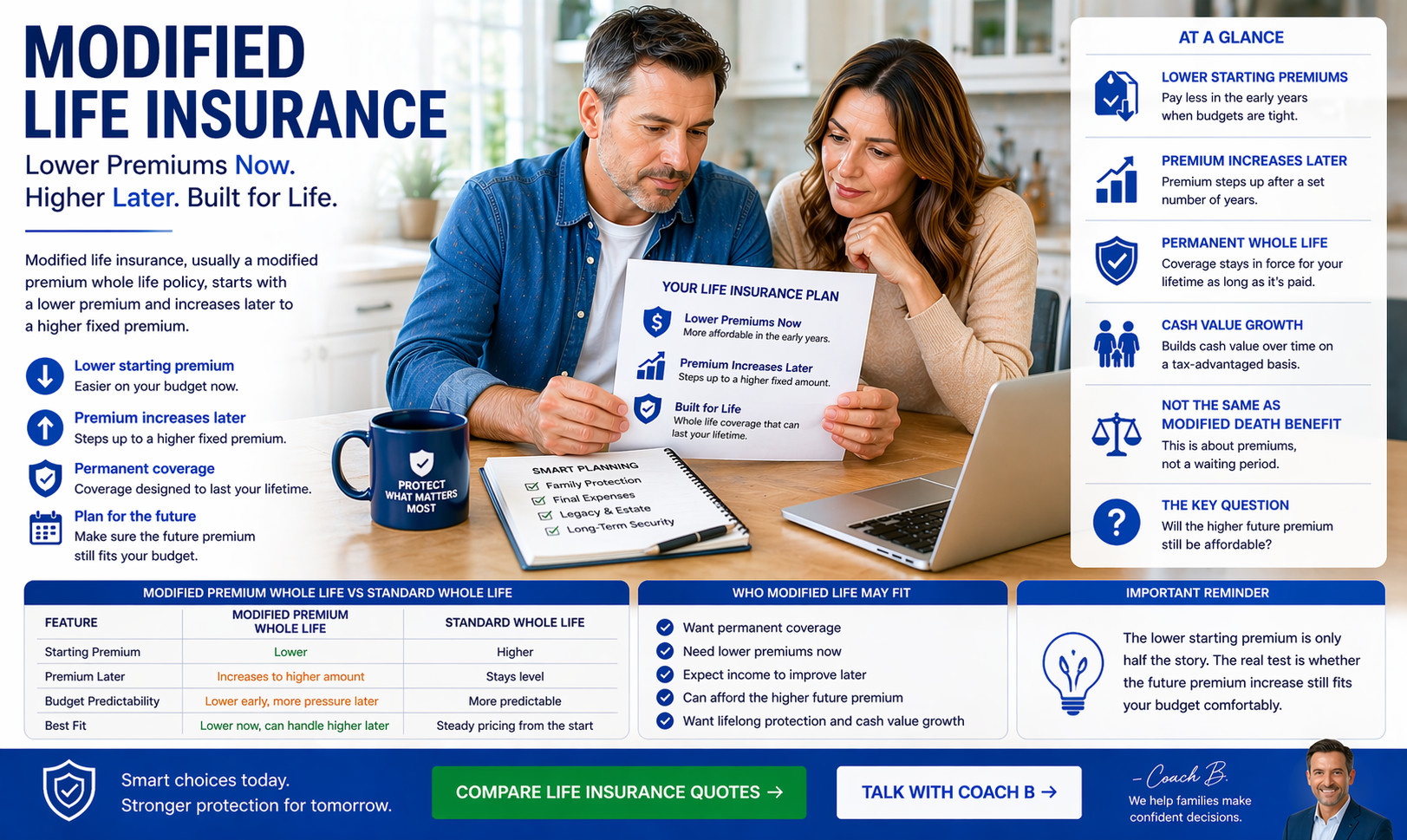
- Modified life insurance usually starts with a lower premium and later increases to a higher premium.
- It is most often discussed as a modified-premium whole life design.
- It is different from a modified death benefit or graded death benefit waiting-period policy.
- The biggest issue is not the lower early premium. It is whether the later premium will still fit your budget.
- If your need is temporary, term life may still be the better fit.

Scott Benton (a.k.a. Coach B.)
Author: Scott Benton, Licensed Life Insurance Agent
Experience: Serving families since 1992
Disclosure: Coach B. Insurance may be compensated if you purchase through our agency. Recommendations are based on product fit, clarity, and usefulness — not pressure.
Editorial note: This page is about modified premium whole life. If your real question is about a waiting period or reduced early natural-death payout, that is usually a modified or graded death benefit topic instead.
What Modified Life Insurance Usually Means
Modified life insurance usually refers to a whole life policy where premiums are lower at first and then increase later to a higher fixed amount. The appeal is obvious: easier early affordability. The tradeoff is just as obvious: higher long-term cost later.
Lower starting premium
The early years are designed to feel more affordable than standard level-premium whole life.
Later step-up
After the introductory period, the premium usually rises to a higher amount.
Permanent-policy lane
This is usually discussed as a whole life or permanent coverage design, not a temporary term structure.
Budget tradeoff
You are often trading easier early affordability for more premium pressure later on.
Modified Premium Whole Life vs Modified Death Benefit
| Concept | What It Usually Means | Main Issue |
|---|---|---|
| Modified premium whole life | Lower premiums early, then a higher premium later | Future affordability |
| Modified death benefit | Reduced early natural-death payout or waiting-period structure | Coverage limitation in the early years |
| Graded death benefit | Another waiting-period / reduced-early-benefit structure often tied to guaranteed issue or final expense | Full payout not immediately available for natural death |
This page is mainly about the first meaning: modified premium whole life.
Why Someone Might Choose Modified Life Insurance
Budget is tight right now
The lower early premium may make permanent coverage possible when standard whole life feels too expensive at first.
Income may rise later
Some buyers expect stronger cash flow in future years and are willing to accept the later premium increase.
Permanent need still exists
The buyer wants lifelong or long-term coverage, not just a temporary term policy.
Trying to avoid no-coverage years
A modified-premium design can sometimes be the middle ground between “too expensive now” and “no permanent policy at all.”
The Biggest Risk: The Premium You Will Have to Afford Later
Why modified life can look attractive
The early premium can make the policy feel like an easier yes, especially for a buyer who wants permanent coverage but is stretched in the short term.
Why buyers can get burned
If you love the lower starting premium but do not plan for the step-up, the future premium can become the problem. That is the main question this policy type creates.
Modified life is usually not a bad idea because the starting premium is lower. It becomes a bad idea when the buyer never honestly stress-tests the later payment.
Modified Life Insurance vs Standard Whole Life
| Question | Modified Life Insurance | Standard Whole Life |
|---|---|---|
| Starting premium | Usually lower | Usually higher |
| Later premium | Usually steps up | Usually stays level |
| Budget predictability | Lower early, more pressure later | More predictable from the beginning |
| Best fit | Buyer who needs easier early affordability and can handle future increase | Buyer who wants steady whole life pricing from day one |
Modified Life Insurance vs Term Life Insurance
When term may be better
- your need is temporary
- you want the lowest cost for the most coverage
- the main goal is income replacement, mortgage protection, or kids-at-home years
- you do not need permanent coverage right now
When modified whole life may be better
- you do want permanent coverage
- standard whole life is hard to afford at the start
- you expect the higher later premium to be manageable
- the policy’s long-term structure still fits your plan
Questions to Ask Before Buying a Modified Life Policy
When does the premium increase?
Know the exact timing, not just the general idea.
How much does it increase to?
The future premium number matters more than the starting teaser number.
Is standard whole life still doable?
Sometimes the best answer is a smaller standard whole life policy instead.
Would term solve the real problem better?
If the need is temporary, term may still be the cleaner solution.
How Coach B Would Shop This
Step 1: decide whether the need is truly permanent
Before talking modified premiums, I would first make sure permanent coverage is actually the right lane.
Step 2: compare modified vs standard whole life
Then I would compare whether the lower early premium is worth the later step-up or whether standard whole life is the smarter long-term buy.
Step 3: stress-test the later payment
If the later premium feels shaky, that is the warning sign. A permanent policy only works if you can realistically keep it in force.
The Bottom Line
Modified life insurance can make sense when you want permanent coverage but need a lower premium at the beginning.
But the lower starting premium is only half the story. The real decision is whether the later premium increase still fits your budget and whether a standard whole life policy or term policy would solve the problem more cleanly.
Helpful Related Pages
Whole Life Insurance Hub
Best next page if you want the broader whole life category before choosing a more specialized permanent policy design.
Explore Whole Life →Term vs Whole Life Insurance
Best next page if your bigger question is whether permanent coverage is even the right lane.
Compare Term vs Whole Life →Graded Death Benefit Life Insurance
Best next page if your real question is about waiting periods or reduced early natural-death benefits instead of modified premiums.
See Graded Death Benefit →Whole Life Insurance Rates
Best next page if cost and premium structure are the next things you want to compare.
See Whole Life Rates →Frequently Asked Questions
What is modified life insurance?
Usually it means a whole life policy with a lower premium at first and a higher premium later on.
Is modified life insurance the same as a graded death benefit policy?
No. Modified premium whole life and graded or modified death benefit policies are usually talking about different things.
Why would someone choose modified life insurance?
Usually because they want permanent coverage but need a lower premium in the early years.
What is the biggest downside of modified life insurance?
The biggest downside is usually the later premium increase and whether it will still be affordable.
Is term life sometimes a better fit than modified whole life?
Yes. If the need is temporary and low cost matters most, term life may still be the cleaner choice.


