
Guaranteed Universal Life vs Term Life: Cost, Coverage, and Best Fit
Guaranteed universal life and term life solve two very different problems. Term is usually the better fit when the need is temporary and you want the most coverage for the monthly dollar. Guaranteed universal life is usually the better fit when the need is permanent and you want a death benefit that can stay in force for life.
That is why this page matters. Most buyers are not really asking which one is “better” in the abstract. They are asking a more practical question: should I buy the cheaper temporary coverage, or do I need permanent protection that does not expire?
This guide breaks down how GUL compares to term life on price, coverage length, flexibility, and real-world buyer fit so you can choose the one that matches the job you actually need the policy to do.
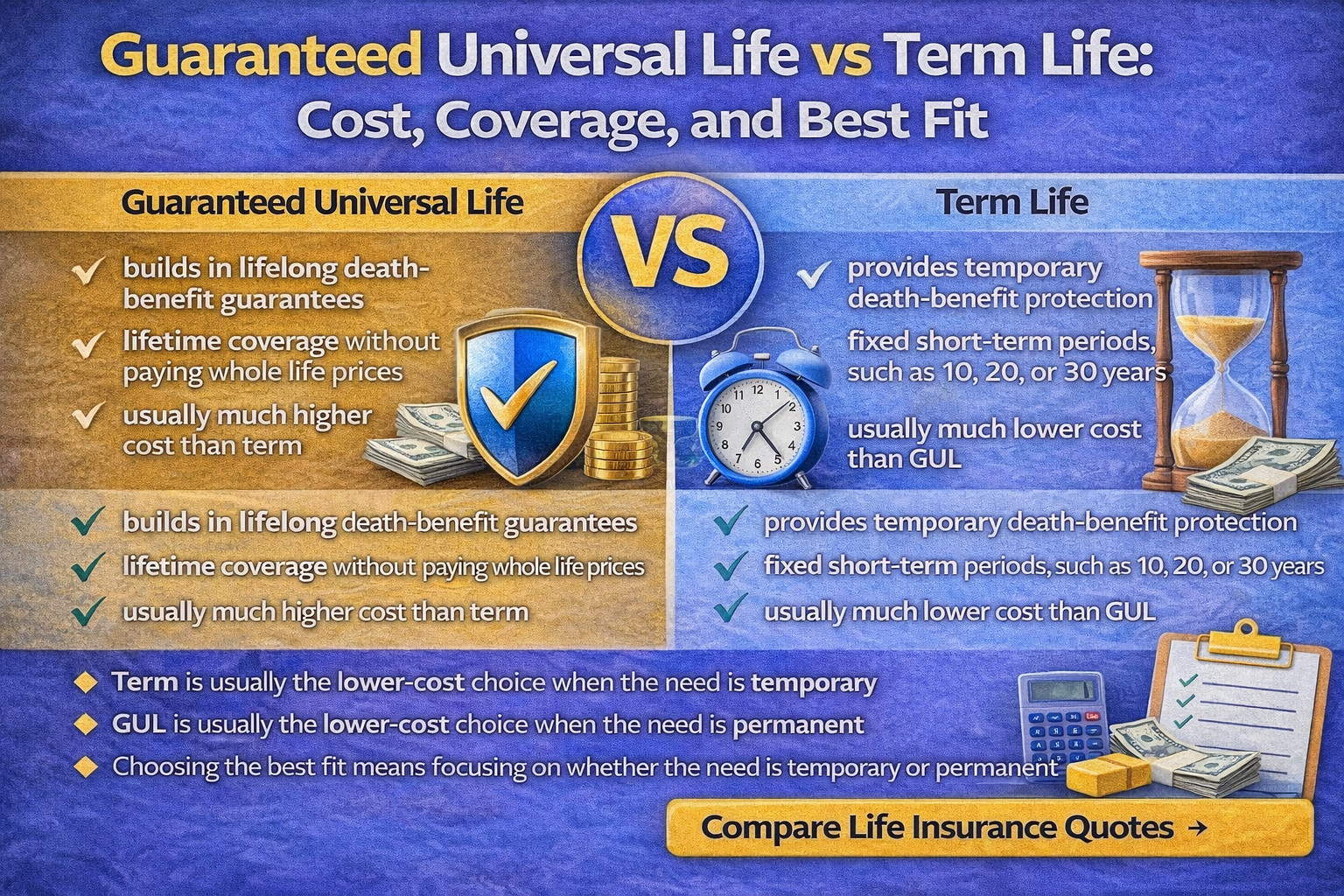
- Term life is usually much cheaper than guaranteed universal life.
- Term life is temporary. GUL is designed for long-term or lifetime death-benefit guarantees.
- Term usually fits income replacement, mortgage protection, and family budget efficiency.
- GUL usually fits estate planning, permanent spouse protection, and lifelong death-benefit needs.
- The smartest move is picking the policy that matches the job, not just the one with the lower monthly premium.

Scott Benton (a.k.a. Coach B.)
Author: Scott Benton, Licensed Life Insurance Agent
Experience: Serving families since 1992
Disclosure: Coach B. Insurance may be compensated if you purchase through our agency. Recommendations are based on product fit, underwriting, clarity, and usefulness — not pressure.
Editorial note: This comparison gets easier once you ask one honest question: is the need temporary or permanent? Once you answer that, term and GUL usually sort themselves out pretty quickly.
The Big Difference: Temporary Coverage vs Permanent Coverage
The main difference between guaranteed universal life and term life is not just the premium. It is the kind of problem each policy is built to solve.
Term life
Term life is temporary protection. It is usually best when the need has an end point.
- income replacement during working years
- mortgage protection
- raising children
- budget efficiency
Guaranteed universal life
GUL is permanent death-benefit coverage. It is usually best when the need does not really go away.
- lifetime spouse protection
- estate planning
- guaranteed inheritance goals
- permanent coverage without whole life pricing
Guaranteed Universal Life vs Term Life Cost
| Feature | Guaranteed Universal Life | Term Life |
|---|---|---|
| Monthly cost | Usually higher | Usually much lower |
| Why it costs what it does | You are paying for long-duration or lifetime death-benefit guarantees | You are paying for temporary protection during a set term period |
| Best value when | The need is permanent | The need is temporary |
| Main mistake | Buying it when the need is temporary | Buying it when the need is actually permanent |
Term usually wins on price. GUL usually wins on permanence. The wrong choice often happens when someone compares premiums without first deciding whether the need lasts for life or not.
Guaranteed Universal Life vs Term Coverage Length
Term life expires
A term policy usually ends after a set number of years, such as 10, 20, or 30 years.
GUL is built for longer guarantees
GUL is designed to keep the death benefit in force for a much longer period, often to an advanced age or for life.
Term is usually simpler
Term is straightforward when the timeline of the need is obvious and temporary.
GUL is usually stronger for lifelong needs
If the need does not really disappear with age, GUL often becomes more relevant than term.
Who Term Life Usually Fits Best
Families needing income replacement
If the main job is replacing income while children are young or while a family depends on one earner, term usually makes the most sense.
Homeowners protecting a mortgage
If the goal is covering a mortgage during a specific payoff period, term is often the better fit.
Buyers needing the most coverage per dollar
If budget efficiency matters most and the need is temporary, term usually wins by a wide margin.
Who Guaranteed Universal Life Usually Fits Best
Buyers needing permanent protection
If the goal is a death benefit that stays in force long term or for life, GUL often makes far more sense than term.
Estate and legacy planners
If the policy is meant for inheritance, estate equalization, or long-term spouse support, GUL usually deserves a closer look.
Buyers wanting permanent coverage without whole life pricing
If whole life feels too expensive but the need is still permanent, GUL often lands in the middle as the better-value solution.
When Term Life Is Smarter Than GUL
Term life is usually smarter when:
- the need has a clear end point
- you need the most coverage for the lowest monthly premium
- the main goal is mortgage protection or income replacement
- you do not actually need permanent coverage
In those situations, paying more for GUL usually adds permanence you may not really need.
When Guaranteed Universal Life Is Smarter Than Term
GUL is usually smarter when:
- the need is permanent and term expiration would create a problem later
- you want a lifetime death benefit without paying whole life prices
- estate planning or inheritance goals matter
- you need longer-term spouse or family protection that does not disappear with age
In those situations, term may be cheaper but still wrong for the job because the need does not go away when the term ends.
How Coach B Would Decide Between GUL and Term
Step 1: define the job
Is the policy meant to solve a temporary family protection problem or a permanent death-benefit need? That answer usually points the direction right away.
Step 2: compare budget honestly
If the premium difference is forcing you to underbuy coverage on a temporary need, term is often the smarter answer.
Step 3: plan for what happens later
If term expiration would leave you exposed on a need that is still there, GUL usually deserves much more weight in the decision.
The Bottom Line
Term life is usually the smarter buy when the need is temporary and you want the most coverage for the monthly dollar. Guaranteed universal life is usually the smarter buy when the need is permanent and you want long-term death-benefit guarantees without paying whole life prices.
The biggest mistake is comparing them only on price. The better question is whether the job is temporary or permanent. Once that is clear, the right policy usually becomes much easier to spot.
Helpful Related Pages
Guaranteed Universal Life Insurance Cost
Best next page if your main question is what GUL usually costs and what changes the premium.
See GUL Cost Guide →Guaranteed Universal Life Insurance Rates by Age
Best next page if you want the narrower age-based GUL chart and sample monthly rate page.
See GUL Rates by Age →Guaranteed Universal Life vs Whole Life
Best next page if the bigger question is lower-cost permanent guarantees versus stronger cash value focus.
Compare GUL vs Whole Life →Term vs Whole Life Insurance
Best next page if you want the broader temporary-versus-permanent insurance comparison.
Compare Term vs Whole Life →Non-Guaranteed vs Guaranteed Universal Life
Best next page if you want to understand how GUL differs from more flexible universal life designs.
Compare GUL Designs →Universal Life Insurance Cost
Best next page if you want the broader pricing picture across universal life policy types.
See Universal Life Costs →20 vs 30 Year Term Life Insurance
Best next page if you are leaning toward term and need help picking the right term length.
Compare 20 vs 30 Year Term →Frequently Asked Questions
Is guaranteed universal life better than term life?
Not automatically. GUL is usually better when the need is permanent. Term is usually better when the need is temporary and budget efficiency matters most.
Why is GUL more expensive than term?
GUL is usually more expensive because it is built to keep a death benefit in force much longer or for life, while term only covers a temporary period.
Who should buy term life instead of GUL?
People who need temporary income replacement, mortgage protection, or the most coverage for the lowest monthly premium usually fit term better.
Who should buy GUL instead of term?
People who need long-term or lifetime death-benefit protection, such as for spouse support or estate planning, often fit GUL better than term.
What is the biggest mistake in a GUL vs term comparison?
The biggest mistake is comparing the price without first deciding whether the need is temporary or permanent. Cheap is not better if it solves the wrong problem.


